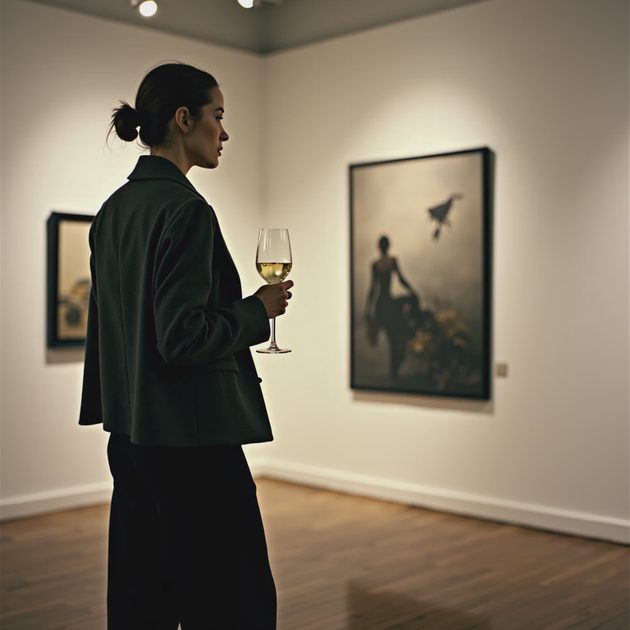
I went to a gallery opening last month in Chelsea. A friend of a friend was showing a series of large-format photographs — moody, abstract, the kind of work that makes you tilt your head and feel something before you know why. The space was white-walled and concrete-floored, lit in that particular gallery way that makes everyone look vaguely like a Hopper painting. I arrived alone, found my friend by the wine table, and spent two hours drifting between photographs and conversation, feeling entirely like myself.
It took me years to dress for an event like this without overthinking it. The first gallery opening I ever attended — years ago, in a different city — I wore a dress that was too short, heels that were too high, and a necklace that jangled every time I turned my head. I spent the whole evening adjusting, tugging, and worrying. I looked like I'd tried very hard, and trying hard at a gallery opening is the surest way to look like you don't belong there.
The outfit I wear now is different. It's built on the same principles I use for every city outing — grounded, walkable, romantic in an understated way — but with a slight elevation that acknowledges the evening. Here is what I wear, piece by piece, and why it works.
The Sculptural Jacket That Does the Talking

The centerpiece of my gallery outfit is a vintage jacket — 1960s, in a deep charcoal wool bouclé with a slightly sculptural shape. The shoulders are defined but not padded, the waist is shaped by a single covered button, and the collar stands away from the neck in a way that frames the face without being dramatic. It's not a blazer. It's not a coat. It's something between the two — a piece that reads as intentional and slightly artistic, the kind of garment a sculptor might wear to her own opening.
What I've learned about gallery dressing is that it rewards a single strong piece. The room is full of visual information — paintings, photographs, projections, people in interesting outfits — and a head-to-toe statement look competes with the art instead of complementing it. A single sculptural piece, worn with quiet companions, lets you move through the space like part of the atmosphere rather than a disruption.
The bouclé fabric matters too. Under gallery lighting — bright spots on the walls, softer pools in the corners — bouclé catches light in a textured, uneven way. It absorbs and reflects at the same time. It reads as complex without reading as shiny. I've worn the jacket to three openings now, and every time, someone touches my sleeve and asks about it. Not because it's loud. Because it rewards a closer look.
The Silk Camisole That Stays Quiet
Under the jacket, I wear a simple silk camisole in cream. No lace, no embellishment, no visible branding. Just a clean neckline — a soft V that sits below the collarbone — and a fabric that moves when I breathe.
The camisole is not the star. It's the quiet partner. It lets the jacket do the architectural work while providing a soft, neutral plane against the face. The cream color reflects a little light up toward my skin, which matters in dim gallery lighting where faces can disappear into shadow. I learned this trick from watching old films: a light color near the face acts as a reflector, keeping you visible even in low light.
The camisole is also practical. Galleries run warm — too many bodies, too much lighting equipment, too little ventilation — and the silk breathes. I can take the jacket off and still feel dressed. I can keep it on and not overheat. The camisole is vintage, 1990s, unlabeled, found in a thrift shop bin for six dollars. It's the kind of piece no one notices, and that's exactly the point.
The Wide-Leg Trousers That Move Like a Skirt
On the bottom, I wear a pair of black wide-leg wool trousers — 1940s navy surplus, altered at some point in their history to fit a woman, with deep pleats at the front and a cut that widens from the hip. They're not a skirt, but they move like one. When I walk, the fabric swings. When I stand still, the pleats fall into soft vertical lines. The effect is fluid and slightly formal, but the trousers themselves are comfortable enough to wear for hours of standing on a concrete floor.
I've written before about the power of trousers that move. In a gallery setting, that movement matters even more. You're never in one place for long — drifting from piece to piece, stepping back to look, leaning in to read a title card, crossing the room to greet someone. Trousers that move with you make that drifting feel graceful. Trousers that pull or pinch or require adjustment make it feel like work. The wide-leg cut, in a substantial wool, swings without effort. It's the closest thing I've found to a skirt's movement with a trouser's practicality.
The black color is deliberate. A gallery opening is an evening event, and black anchors an outfit in evening without pushing it into formal. These trousers, with the charcoal jacket and the cream camisole, read as nighttime without reading as "night out." The distinction is subtle but real. An outfit for looking at art should have a different register than an outfit for dancing or drinking or being seen. It should be quieter. Slower. More receptive.
The Shoes That Survive Concrete Floors
Gallery openings involve a surprising amount of standing. There are rarely enough chairs. The concrete floors are unkind to heels. The lighting is dim enough that you might step on a wine cork or catch the edge of a platform and no one will see it happen, but your ankle will remember.
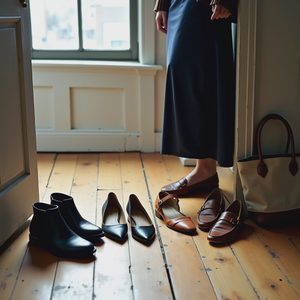
I wear the same black leather ankle boots I reach for on most city evenings — low stacked heel, almond toe, broken in over years of pavement and gallery floors and subway stairs. They're polished enough to read as intentional in a room full of art, but grounded enough that I don't think about my feet once. I've learned that thinking about your feet during a conversation about abstract photography is a particular kind of misery. The boots free me from that.
If it's summer, I wear a pair of black leather block-heel sandals — the same ones I wrote about in the city shoes essay. Two inches at most, ankle strap, sole thick enough to survive the walk from the station. The block heel gives enough lift to feel like I dressed for an occasion, but not so much that I'm wobbling on uneven gallery floors or sinking into the gaps between cobblestones on the street outside.
The shoe principle is simple: no one at a gallery opening is looking at your feet. They're looking at the art, and then they're looking at your face, and then — maybe — they're looking at your jacket. Your shoes only need to do two things: not hurt, and not distract. If they can do those two things and still feel like they belong to the woman wearing the silk, they're the right shoes.
The Small Detail That Makes It Mine
Every outfit I wear to a gallery opening has one small, personal detail — something that has no function except to make me feel like I showed up for myself. Sometimes it's a vintage brooch pinned to the lapel of the jacket — a small abstract shape in tarnished silver that catches the light and prompts a question from someone standing too close to a photograph. Sometimes it's a silk scarf tied at the wrist, or a ring that belonged to my grandmother, or a pair of earrings so small only I know they're there.
These details are not for the room. They're for me. They're the private anchor that keeps an evening outfit from feeling like a performance. When I'm standing in front of a photograph, holding a glass of wine that's slightly too warm, I'll catch sight of the brooch or feel the scarf against my wrist, and remember: I dressed for this. I chose this. This is my evening, not an audition.
The key to this detail is that it should be small enough to feel private. A large, attention-seeking accessory — a statement necklace, an oversized cocktail ring, a pair of dramatic earrings — competes with the art and the conversation and the face wearing it. A small detail recedes into the outfit until someone notices it, and then it becomes a moment of connection. A woman leans in, says "I love your brooch," and suddenly you're talking about thrift shops and grandmothers and the strange silver things we collect for no reason. That's the point.
The Final Test: Do I Look Like I Belong Here?
Before I leave the apartment for any gallery opening, I do the test I've been refining for years. I stand in front of the mirror and look at myself through the imagined eyes of someone at the event, and I ask one question: Does she look like she belongs here, or does she look like she's trying to belong here?
The difference is in the effort. An outfit that tries too hard — too much jewelry, too much skin, too much trend, too much heel — broadcasts its effort from across the room. An outfit that belongs lets the woman arrive before the clothes do. It says: I am here to look at art, not to be looked at. I dressed with care, but my care is in service of the evening, not in service of being seen.
This is the quiet confidence I want in every gallery outfit. Not "look at me," but "I'm here, I'm present, and my clothes are exactly right for this room." When I get it right, I stop thinking about what I'm wearing by the time I reach the first photograph. The outfit has done its job and receded. I spend the evening in conversation, in contemplation, in the particular pleasure of being alone in a room full of people who are also alone, all of us looking at something beautiful together.
Style should feel collected, not crowded. And a gallery opening, with its white walls and careful lighting and rooms full of things made by people who couldn't stop themselves from making them, is exactly the kind of evening that rewards a collected woman. Dressed not for the photograph, not for the crowd, not for the imaginary critic in the corner — but for herself, and for the art, and for the quiet pleasure of moving through a beautiful room in clothes that understand where they are.

No letters yet — be the first to write.