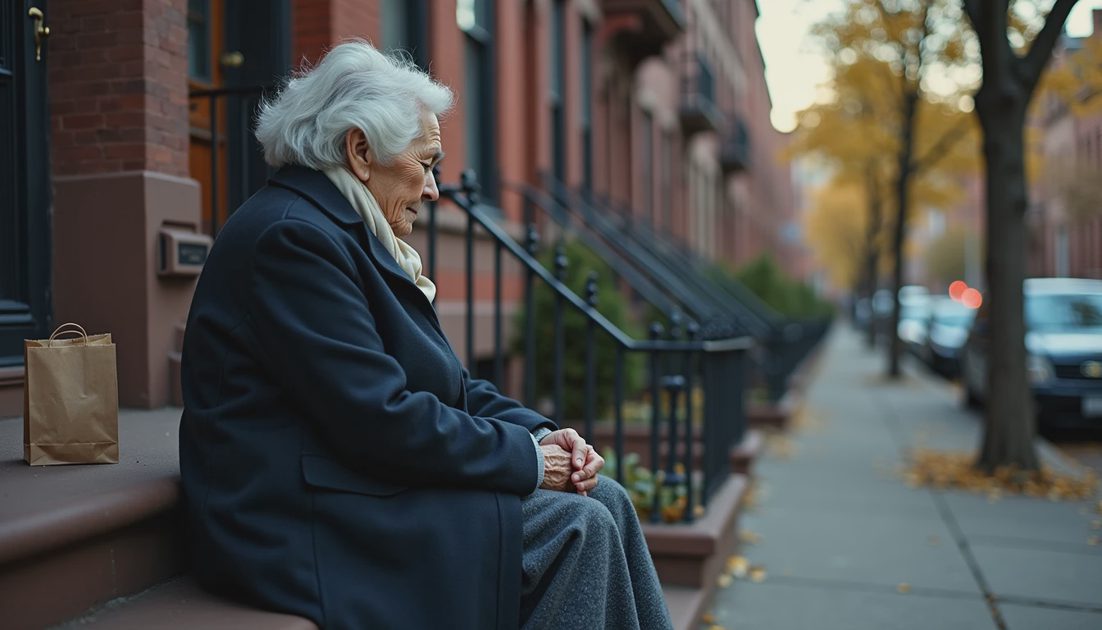
There is a woman I see sometimes on my block. She must be in her late seventies, maybe eighty. She wears the same navy wool coat every winter — single-breasted, slightly boxy, probably from the 1980s, with deep pockets that she rests her hands in when she stands waiting for the bus. Underneath, I've glimpsed a cardigan in heather grey, a silk scarf tied at the neck in a way that looks automatic rather than arranged. Her shoes are low and practical, but never ugly. Her hair is white and short and she never wears a hat, even in the cold. She walks slowly, but not weakly. She looks like someone who has been dressing the same way for forty years and has never once wondered if she should change.
I don't know her name. I've never spoken to her. But I've learned more from watching her wait for the B48 than I learned from years of reading style guides and trend reports and the endless, anxious churn of fashion media. She doesn't know she's teaching me anything. That's part of the lesson.
This essay is about her, and about the other older women in my neighborhood whose style I've been quietly studying for years. Not to copy them — I'm thirty-one, not seventy-eight, and my life demands different clothes than theirs. But to understand something deeper about what happens to personal style when it's been lived in long enough to forget it's being watched.
The Woman in the Navy Coat
I want to start with the woman on my block, because she was the first one I noticed. Noticed, really noticed — the way you notice a painting you've walked past a dozen times and then one day it stops you.
What struck me first was the consistency. The same coat, winter after winter. The same scarf, or what looked like the same scarf. The same low shoes. I started looking for her without meaning to. On Tuesday mornings, she walks to the bakery on the corner and comes out with a single paper bag. On Thursday afternoons, she sits on the bench near the community garden, even in weather that isn't quite warm enough for sitting. She is always dressed exactly the same — not in a uniform, exactly, but in a narrow language of pieces that all know each other.
The lesson of the navy coat took me years to name. I think now it's this: a good coat is not a fashion choice. It's a companion. This woman's coat has been with her through winters I can only guess at. It has shaped itself to her shoulders. The sleeves have shortened slightly from years of being pushed up at the wrist. The collar has softened in a way that new wool never does. The coat doesn't look new, and that's why it looks beautiful. It looks like a life, not a purchase.
I own a navy coat myself — vintage, 1960s, wool gabardine. I bought it three winters ago and I plan to keep it until the lining gives out and then I will have the lining replaced and keep it longer. I used to worry that wearing the same coat every day meant I was failing at style — that variety was the goal, that a woman who repeated herself had given up. This woman, standing at the bus stop with her hands in her pockets, taught me otherwise. Repetition is not failure. Repetition is depth. A coat worn every day for ten years knows you in a way a coat worn twice a season never will.
The Bakery Line and the Art of the Worn Cardigan
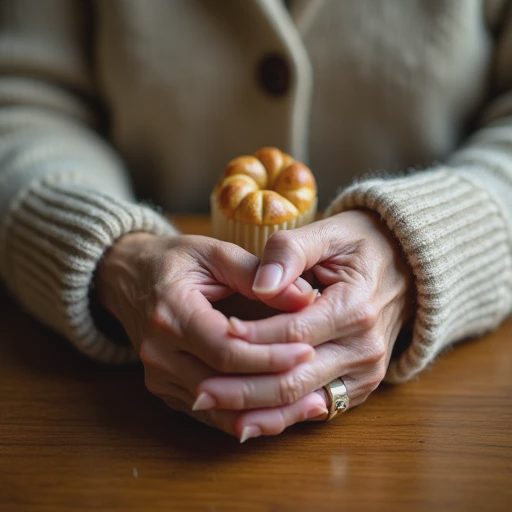
On Saturday mornings, I go to a bakery on Franklin Avenue. The line is always long, and I spend most of it looking at what people are wearing — not out of judgment, but out of genuine curiosity. Saturday morning is the most honest style moment of the week. No one is dressed for an occasion. No one is performing. People are wearing what they reached for in the five minutes between waking up and wanting a croissant.
There is an older woman who is often in line ahead of me. She wears a cardigan in a shade of oatmeal that has clearly been washed too many times — the elbows are slightly felted, the cuffs are stretched, the buttons don't quite match. One has been replaced with a similar-but-not-identical button in a slightly darker tone. The replacement is visible if you look closely. I look closely.
What this cardigan taught me, over many Saturday mornings, is that the most beautiful garments are the ones that have been loved past the point of perfection. A new cardigan is a promise. A worn cardigan is a history. The felted elbows mean she leaned on something — a table, a desk, a windowsill — for hours, for years. The stretched cuffs mean she pushed the sleeves up, probably without thinking, a thousand times. The mismatched button means the original fell off and she cared enough to sew on a replacement rather than throwing the whole cardigan away.
I used to treat my clothes like they needed to stay pristine. A moth hole was a tragedy. A loose button was a failure of maintenance. A slightly felted sweater was a candidate for donation. I was wrong. A moth hole is proof that wool is wool, not plastic. A loose button is an invitation to sew. A felted cardigan has been worn, and wearing is the whole point.
Now, when I thrift, I look for the cardigans that have already been loved. The ones with the stretched cuffs and the replaced buttons and the small, invisible repairs. They've already proven themselves. They've already lived with someone for years and been kept, mended, kept again. That's the kind of cardigan I want to become the woman who wears.
The Stoops at Dusk and the Vanishing Body
In the summer, the older women in my neighborhood sit on their stoops in the early evening. It's a ritual I've watched for years — they come outside as the heat breaks, carrying a drink or a phone or nothing at all, and they sit and watch the street. Their clothes in these moments are not clothes at all, really. They're cotton house dresses, loose linen trousers, oversized shirts, worn sandals. Things that have ceased to be outfits and have become something closer to skin.
I used to think that style was about the body — about shaping it, defining it, making it look a certain way. The women on the stoops have taught me something different. At a certain point, style stops being about the body and starts being about the person inside it. The clothes become so familiar, so lived-in, so un-self-conscious, that they recede. What you see is not the dress. What you see is the woman, sitting on the stoop, watching the street, completely at home.
This is a kind of style that fashion media never talks about because it can't be photographed in a way that sells anything. It's not aspirational. It's not a trend. It's not even particularly visible. It's the absence of performance — the point at which clothing becomes so personal, so integrated into the life wearing it, that it stops being fashion at all.
I'm thirty-one. I'm not there yet. I still dress with some awareness of being seen, some desire to communicate something about myself through my clothes. But I dress with less of it than I did at twenty-five, and less then than I did at twenty. The trajectory is clear, and the women on the stoops show me where it leads. Not to invisibility. To presence. To being so fully in your body, in your clothes, in your evening, that the question of how you look dissolves into the fact of who you are.
What I'm Collecting Now
These women are not my friends. I've never asked their names. Our relationship is entirely one-sided — I watch, they exist, and the watching is a kind of education they will never know they provided. But I'm collecting their lessons, and they're changing the way I dress.
Here is what I'm collecting now:
The coat I'll still be wearing in twenty years. My navy gabardine is three winters old. I've had the lining repaired once. The cuffs are beginning to show the faintest shine from wear. I notice the shine, and instead of worrying, I think of the woman at the bus stop.
The cardigan with the mismatched button. I have one now — a fawn cashmere cardigan from the 1950s, with a small moth hole near the hem and one button that's slightly lighter than the others. I used to think about finding a replacement button. Now I think about leaving it. It's a mark of having been loved, and I'm adding my own love to it.
The willingness to repeat. I wear the same coat every day in the winter. I wear the same cardigan three times a week. I used to worry that this meant I was boring. Now I understand that repetition is the mechanism by which clothes become yours. You can't have a signature coat if you wear a different coat every week. You can't have a beloved cardigan if you're constantly rotating in new ones. Depth requires time, and time requires repetition.
The long view of a wardrobe. I'm not dressing for this season. I'm dressing for the woman I'll be in twenty, thirty, forty years — the one who will still have this navy coat, this cashmere cardigan, these leather boots, because I chose well and kept them close. The older women in my neighborhood don't know they're teaching me to take the long view. But they are.
Style should feel collected, not crowded. And the women I've been watching for years — silently, from across the bakery line, from the other side of the bus stop, from my own stoop in the summer dusk — have collected their style over decades. Not in a rush. Not for an audience. Not with any awareness that a younger woman was taking notes.
They dress like they've stopped performing. Not like they've stopped caring — the woman in the navy coat clearly cares; you don't keep a coat that long without care — but like they've stopped caring about the wrong things. The approval of strangers. The pressure of trends. The anxious question of whether this outfit is "right" for this moment. They've shed all of that, gradually, over years of dressing for real mornings and real weather and real lives.
I'm not at the end of that journey yet. I'm somewhere in the middle — still taking pleasure in being seen, still enjoying the small theater of getting dressed, still writing essays about what I wore and why. But I know where the road leads. I can see it from my window, every evening, when the older women come out to sit on their stoops in their cotton dresses and worn sandals, completely at home in themselves. That's the destination. Not the perfect wardrobe. The perfect ease.

No letters yet — be the first to write.