I once wore a pair of beautiful vintage heels to a friend's apartment in Manhattan. They were 1950s, in dark green suede, with a slim three-inch heel and a pointed toe that made my feet look like they belonged to someone far more elegant than I am. I took the subway there. I walked six blocks from the station. By the time I arrived, I had blisters on both heels and a deep, radiating ache in the balls of my feet that didn't fade until the next morning. I stayed seated for most of the evening — not because I wanted to, but because standing up meant admitting how much pain I was in.
That was the night I stopped pretending city shoes and romantic shoes were different categories. They aren't. Or rather, they can't be — not if you actually live in a city and walk its streets and take its trains and climb its stairs. A romantic wardrobe that only works when you're sitting down is not a romantic wardrobe. It's a costume, and costumes don't survive real life.
Here is what I wear now. No stilettos. No suffering. Just shoes that let me walk, and still feel like they belong to the woman wearing the silk skirt.
The Low-Heeled Boot That Does Everything
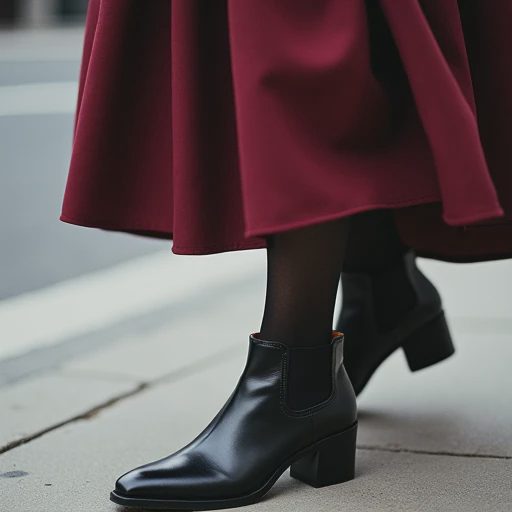
If I could keep only one pair of shoes for the rest of my city life, it would be this pair: black leather ankle boots with a low stacked heel — an inch and a half, maybe slightly less — and a rounded almond toe. They're not vintage, though I've owned vintage versions of them. These are from a contemporary brand that specializes in comfort, and I bought them three years ago after a long search for something that could handle rain, snow, subway grates, and ten-thousand-step days without making me miserable.
What makes them work with a romantic wardrobe is everything they don't do. They don't compete. They don't announce themselves. They don't read as a specific decade or a specific trend or a specific anything. They're just boots — well-proportioned, quietly elegant, dark enough to recede and let the rest of the outfit speak.
I wear them with bias-cut midi skirts and wool A-line skirts and wide-leg trousers and, occasionally, a silk dress that hits just below the knee. The low heel gives enough lift to keep the proportions from feeling heavy — a completely flat boot with a midi skirt can make the whole silhouette drag — but not enough to change my stride or compromise my ability to walk at full Brooklyn pace.
The almond toe is the quiet hero here. A pointed toe reads as more formal and more aggressive, and it changes the way a skirt looks — sharpening the silhouette rather than softening it. A rounded toe can read clunky with delicate fabrics. The almond toe splits the difference. It's soft enough to sit beneath a silk hem without looking like a work boot, structured enough to ground an outfit in reality. If you're looking for one boot shape that works across nearly every romantic silhouette, this is it.
The Ballet Flat That Isn't a Costume
Ballet flats are the most obvious romantic shoe choice, and for years I avoided them for exactly that reason. They felt too literal — too Audrey Hepburn, too ingenue, too much like I was dressing as an idea of femininity rather than a woman who actually needs to walk from the L train to a café in Carroll Gardens.
What changed my mind was finding the right pair. Not the delicate, ribbon-tied, paper-thin-soled flats that look beautiful on a dresser and disintegrate after three city blocks. Real ballet flats — or rather, flat shoes inspired by ballet but built for streets. The pair I wear now are black leather with a subtle square toe, a slight heel — barely a quarter inch, just enough to keep the sole from being completely flat — and a cushioned insole that I didn't fully appreciate until I wore them for a full day of walking and realized my feet didn't ache at all. They're not vintage. They're practical shoes that happen to look graceful.
What makes them work with a romantic wardrobe is their neutrality. Like the black ankle boots, they recede. They let the silk skirt or the wool dress or the vintage lace blouse do the talking. But unlike the boots, they expose the ankle and the top of the foot, which changes the proportion of every outfit they touch. A midi skirt with boots reads as grounded and cool-weather. The same midi skirt with ballet flats reads as lighter, more feminine, more open to the air. Having both options in my closet means I can modulate the mood of an outfit without changing anything else.
The practical note: look for flats with a sole thick enough to survive pavement. A leather sole is elegant, but it wears through quickly on city sidewalks, and damp concrete is slippery in a way that cobblestone streets in old films never prepared you for. A thin rubber sole — not a lug sole, nothing chunky, just a quiet layer of protection — is the difference between a flat you replace every season and a flat you wear for years.
The Block-Heel Sandal That Survives Cobblestones
Summer in the city is a test of shoe judgment. The pavement is hot. The sidewalks are crowded. The subway stairs are slick with humidity and, depending on the line, substances I'd rather not name. A delicate strappy sandal with a stiletto heel is not a shoe for this environment. I learned this the hard way — caught in a summer downpour on Franklin Avenue, trying to run for the bus in a pair of heeled sandals that had approximately as much traction as wet soap.
Now I wear block-heel sandals. A low block — two inches at most, usually closer to an inch and a half — with a wide base that doesn't wobble on uneven pavement or catch in subway grates. The pair I reach for most often are tan leather with two slim straps across the toe and an ankle strap that keeps everything secure without cutting into my skin. The shape is vaguely 1940s — that sturdy, elegant heel shape you see in photographs of women walking through wartime cities — but the construction is modern, with a padded footbed and a rubber heel cap that absorbs impact.
Block heels work with a romantic wardrobe because they carry visual weight without visual aggression. A stiletto reads as sexy, sharp, formal. A block heel reads as composed, steady, intentional. It gives the same height lift as a stiletto — enough to change the line of the leg, to make a bias-cut skirt hang correctly, to add a little presence to the silhouette — but it communicates a different message. Not "look at me," but "I'm here, I'm dressed, I can walk wherever I need to go."
The ankle strap matters more than you'd think. An ankle strap keeps the shoe on your foot when you're walking fast, which is the only speed city life allows. A backless mule, however beautiful, requires a shortened, careful stride — the kind of walk that reads as dainty and feels like holding your breath. An ankle strap sets you free. You can stride. You can catch the train. You can walk twelve blocks in August heat and not once worry about your shoe slipping off on a crosswalk.
The Loafer That Reads as Intentional
Loafers are having a long cultural moment, which means they're available everywhere and easy to find. But I've been wearing them for years, because a well-made loafer solves a specific problem in a romantic wardrobe: it's flat, walkable, and polish-adjacent, but it doesn't read as delicate or girlish the way a ballet flat can. A loafer is a shoe for a woman who wants to look like she dressed herself with care, not like she's waiting for someone to notice how fragile she is.
My loafers are brown leather, vintage 1980s, made in Italy, found at a consignment shop for thirty dollars. They have a low stacked heel — barely there, but enough to give the sole some structure — and a slightly elongated toe that keeps them from looking stubby. The leather is soft from years of wear, and the sole is thin enough to feel the ground but thick enough to survive it.
Loafers work particularly well with trousers — high-waisted, wide-leg vintage trousers in wool or cotton twill — and with A-line skirts that hit at the knee or just below. They add a note of androgyny to an outfit that might otherwise float away into pure romance. That tension — the feminine skirt, the grounded shoe — is where I live now, style-wise. It's the difference between an outfit that feels like a costume party and an outfit that feels like a woman who knows what she's doing.
The practical note: if you're buying vintage loafers, check the heel cap. A worn-down heel cap can be replaced by a cobbler for very little money, but if the wear has been neglected long enough to damage the heel itself, the repair gets more complicated. I learned to check this after buying a beautiful pair of 1960s loafers that turned out to have a heel worn down to the wood. The cobbler fixed them, but it cost more than the shoes.
What These Shoes Have in Common
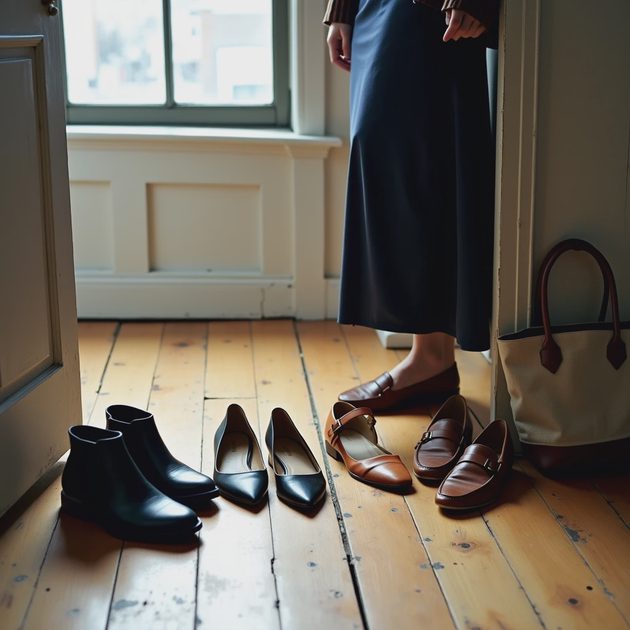
If you look at the list — low-heeled ankle boots, practical ballet flats, block-heel sandals, leather loafers — a pattern emerges. None of these shoes are attention-seeking. None of them are the focal point of an outfit. None of them are painful, or precarious, or designed for a version of city life that doesn't involve walking. They all recede, just enough, and let the rest of the outfit speak.
That's the real test of a city shoe for a romantic wardrobe. Not whether it's pretty — plenty of shoes are pretty — but whether it's generous. A generous shoe supports the outfit without upstaging it. It lets you move through the day without reminding you it's there. It works with the silk skirt and the wool trousers and the vintage dress and the modern cardigan, and it doesn't demand a specific decade or aesthetic in return.
I still have the dark green suede heels. They're in my closet, on a shelf, waiting for an occasion that involves a car or a very short walk from a taxi to a restaurant. I wear them maybe twice a year. They're beautiful, and I love them, and they are not city shoes. City shoes are the ones I reach for the other three hundred and sixty-three days of the year — the ones that let me walk, and feel romantic, and never once think about my feet until I'm home again and slipping them off by the door.
Style should survive real life. And real life, in a city, starts from the ground up. A romantic wardrobe that ends at the ankle — beautiful skirts, silk blouses, vintage coats, and then a pair of shoes that can't handle the sidewalk — is a wardrobe waiting for a different life. The shoes I've described here are not the most exciting shoes in the world. They're the ones I trust. They've walked miles and climbed stairs and stood on train platforms in the rain. And they've done it all while looking like they belong to the woman wearing the silk.
Pretty shoes are easy. City shoes that still feel romantic are harder. But once you find them, you stop thinking about your feet entirely. And that's when the outfit really begins.


No letters yet — be the first to write.