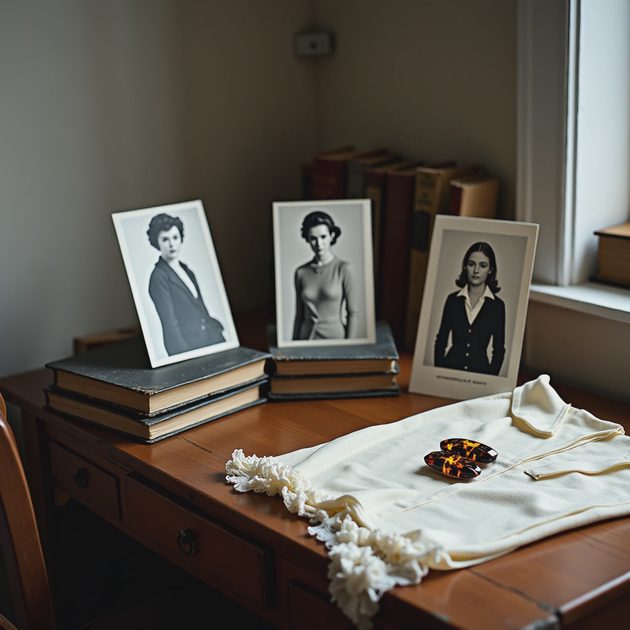
There is a kind of screen presence that has nothing to do with exposure. A high neckline. A long sleeve. A color so subdued it barely registers as a choice. A woman who enters a scene without the clothes entering first. I've been drawn to these characters my entire film-watching life — not because they're the most glamorous or the most referenced, but because they understand something that took me years to learn: restraint is not absence. It's a form of confidence so complete it doesn't need to prove itself.
This essay is about three of those heroines. Three women from different decades, different genres, different costume designers. What they share is a wardrobe built on the quietest possible terms — and a presence that, decades later, still holds the screen without once raising its voice.
Alicia Huberman in Notorious (1946): The Power of the Covered Collarbone
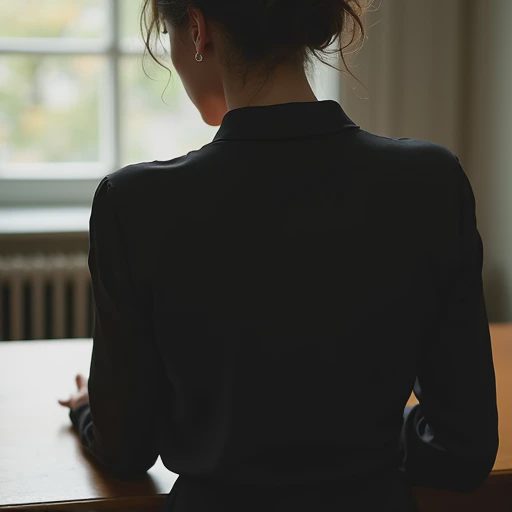
There is a scene early in Alfred Hitchcock's Notorious where Alicia Huberman, played by Ingrid Bergman, is drunk and reckless and spiraling. Her father has just been convicted of treason. She's hosting a party she doesn't care about. She's wearing a striped top, rumpled and casual, and her posture is loose with alcohol and grief. It's the most undone we ever see her. From that point forward, as the plot tightens and her mission begins, so does her wardrobe.
Costume designer Edith Head dressed Bergman in a series of suits, jackets, and structured day dresses that became steadily more restrained as the film progressed. Necklines rose. Silhouettes sharpened. The palette stayed dark, muted, severe. By the time Alicia is descending into the wine cellar on her dangerous mission, she's wearing a black jacket with a high neckline and a slim skirt — covered from throat to wrist to ankle. No skin. No distraction. Just a woman holding herself together under impossible pressure.
What this wardrobe understood is that restraint communicates containment. Alicia is a woman who cannot afford to be vulnerable. Her body, her face, her every gesture is being watched — by the man she loves, by the enemy she married, by the camera itself. The high neckline and the long sleeve protect her. They armor her. They tell the audience: this woman has learned to reveal nothing, because revealing anything might kill her.
What we can borrow now: the power of the covered collarbone. A high-necked silk blouse or a jewel-neck dress changes the way you carry yourself. It projects composure. It tells the world you're observing rather than performing. It's a quiet, confident choice — and it works just as well in a meeting or a café as it does in a Hitchcock film.
Emily Barham in The Americanization of Emily (1964): The Soft Uniform
Julie Andrews plays Emily Barham, a British war widow and motor pool driver during World War II, in a film that is ostensibly a comedy but contains one of the most affecting anti-war speeches ever delivered on screen. Her wardrobe, designed by Bill Thomas, is small and specific: a series of simple, functional uniforms — a driver's coat, a wool skirt, a cardigan, a beret — that she wears almost interchangeably throughout the film. There is nothing glamorous about any of it. She is not a love interest in satin. She is a woman who has lost people she loved, who works a job that matters, who dresses for the weather and the task and not for the male gaze.
What makes Emily's wardrobe remarkable is its refusal to perform femininity in the expected cinematic way. She is beautiful, and the film knows it, but the clothes never announce it. The cardigans are thick. The skirts are practical. The beret is pulled down against the cold, not tilted for effect. She wears the same pieces again and again, and this repetition creates something rarer than glamour: authenticity. She looks like a real woman living through a real war, not an actress costumed for a romantic lead.
What we can borrow now: the soft uniform. The idea that a small collection of pieces, worn repeatedly and without apology, can communicate more than a closet full of statement garments. A well-made cardigan. A wool skirt that fits perfectly. A coat that does its job. Emily's restraint wasn't about deprivation — it was about having exactly what she needed, and nothing that distracted from who she was.
Wanda in Wanda (1970): Dressing Like You've Stopped Performing
Barbara Loden's Wanda is one of the most quietly devastating films I've ever seen, and the wardrobe — such as it is — is inseparable from the character. Loden herself plays Wanda, a woman drifting through rural Pennsylvania coal country after leaving her husband and children. She wears curlers in her hair. A cheap printed blouse. A skirt that doesn't fit quite right. White boots that have seen better days. There is no glamour, no styling, no effort to make the character visually appealing in the way cinema usually demands of its women.
This is restraint at its most radical: clothing that refuses to perform at all. Wanda doesn't dress for anyone — not for men, not for the camera, not for herself. Her clothes are what's left when you stop dressing as a social act. They're the wardrobe of someone who has given up on being looked at, and in that surrender, there's a strange, uncomfortable power.
What Wanda's clothes teach us is the negative space of style: what happens when you remove the performance entirely. Most of us aren't interested in dressing like Wanda — the white boots alone are a choice I won't be making — but there's something valuable in the reminder that clothes can be neutral. They can be functional. They can be an afterthought. And sometimes, seeing that extreme makes the middle ground — intentional, restrained, personal dressing — feel more like a choice and less like a default.
What we can borrow now: the permission to stop performing. Not entirely — most of us have jobs and social lives and a genuine love for beautiful clothes that Wanda didn't share. But we can borrow the idea that dressing for an audience — even an imagined one — is optional. That an outfit can be just for you, completely neutral to the outside gaze, and that this neutrality is its own kind of power.
What These Three Heroines Share
Alicia Huberman, Emily Barham, and Wanda belong to different worlds. A Hitchcock thriller. A wartime satire. An independent film shot on a shoestring budget. They would never share a dinner table, let alone a wardrobe. But their clothes share a philosophy, and it's the philosophy I keep returning to as I build my own relationship with vintage style.
Restraint is a form of self-containment.
All three women, in very different ways, are holding themselves together. Alicia is holding secrets. Emily is holding grief. Wanda is holding the frayed edges of a life that's come apart. Their clothes don't fix any of this — clothes can't — but they don't add to the noise. They let the women exist without the wardrobe demanding attention that belongs to the face, the voice, the story.
Covered is not the same as hidden.
There is a difference between dressing to disappear and dressing with quiet presence. These three heroines are all covered — high necklines, long sleeves, functional layers — but none of them disappears. The coverage isn't about erasing the body. It's about letting the body recede enough that the person becomes visible.
Repetition is not a failure of style.
Emily Barham wears the same pieces over and over. Wanda has barely three outfits in the entire film. Alicia's wardrobe is larger — she's the leading lady in a major studio production — but it's tightly edited, each piece a variation on the same restrained theme. None of these women treat their closets as entertainment. Their clothes work, and then they get out of the way.
How I Borrow from These Heroines Now
I don't dress like any of these characters. I'm not walking around Brooklyn in a 1940s Hitchcock suit or a 1960s British motor pool uniform. But I think about them constantly when I'm standing in front of my closet, trying to decide what kind of presence I want to bring into the day.
From Alicia, I borrow the high neckline when I want to feel contained and composed. A silk blouse with a jewel neck, a merino turtleneck under a jacket — pieces that cover without hiding, that project calm.
From Emily, I borrow the soft uniform. The cardigan I reach for three times a week. The wool trousers that work with everything. The idea that a small, well-made wardrobe is more valuable than a large, exploratory one.
From Wanda, I borrow the permission to stop dressing for an audience. To wear what feels neutral, what feels like nothing, what feels like me on a day when I don't want to perform. There are days when style is a language, and there are days when it's just clothes. Both kinds of days are valid.
Style should feel collected, not crowded. And the collection I'm building, slowly, is as much about the heroines I love as it is about the pieces themselves. Not the costumes. Not the exact dresses, the precise suits, the screen-accurate reproductions. The restraint. The confidence to say less. The quiet presence of a woman who knows she doesn't need to raise her voice — or her hemline — to be remembered.
No letters yet — be the first to write.