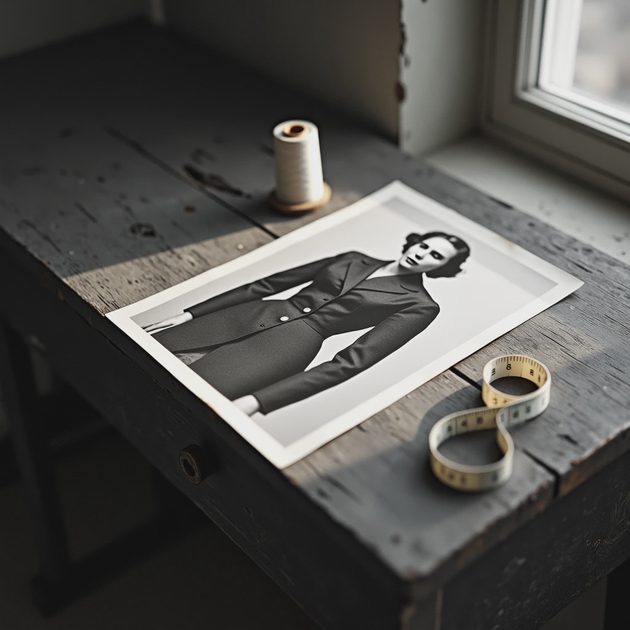
I have a folder on my phone filled with old photographs. Not family photographs — I'm talking about film stills, studio portraits, street photography from the 1940s and 1950s, scans of old issues of magazines I've found in thrift shops and library archives. I return to this folder constantly, not for the faces, but for the clothes. The cut of a jacket. The hang of a sleeve. The way a waistline meets a belt. And every time I scroll through, I'm struck by the same thought: these clothes looked made for the camera in a way most modern clothing doesn't.
It would be easy to attribute this to nostalgia, or to the soft glamour of black-and-white film, or to the fact that people in old photographs simply dressed more formally. But I don't think it's any of those things. I think it's structure. Specifically, I think it's the soft waist and the strong shoulder — two tailoring principles that defined mid-century garment construction and happened to be extraordinarily photogenic. This essay is about why they worked, what they did for the body, and what they still have to teach us about silhouette, even if you never stand in front of a camera more demanding than your own hallway mirror.
What the Camera Sees That the Eye Overlooks
Before I get into the waist and the shoulder themselves, it's worth understanding why some clothes photograph better than others at all. The human eye is forgiving. It adjusts for movement, compensates for proportion, and fills in gaps with the brain's own sense of how a body ought to look. A dress that slouches slightly at the waist or a jacket that droops at the shoulder reads as acceptable in real life because we see it in motion, in context, surrounded by the rest of the person wearing it.
A still photograph has no such generosity. The camera flattens three dimensions into two. It freezes fabric mid-swing or mid-settle. It exaggerates any lack of structure because it can't ignore a sloping shoulder or a vanished waist the way a human observer can. The camera is a ruthless structural critic, and it rewards clothes that supply their own architecture.
This is why so much modern clothing — soft, stretchy, unstructured, designed for comfort over silhouette — photographs poorly. It relies on the body to provide the shape. When the photograph flattens the body, there's nothing left to hold the line. Vintage clothing from the 1940s and 1950s, by contrast, was built with an internal logic. It didn't ask the body to do the work. It provided a frame for the body to inhabit. The two most important elements of that frame were the shoulders and the waist.
The Strong Shoulder: Architecture You Wear
The strong shoulder in vintage clothing is often misunderstood. People hear "strong shoulder" and they think of aggressive 1980s power suits — linebacker padding, massive proportions, shoulders that enter the room before the rest of you. But the strong shoulder I'm talking about predates all of that. It was a tailoring principle of the 1940s and early 1950s, and it was far more subtle and far more beautiful.
A well-constructed vintage jacket or dress from this period builds the shoulder line with a combination of precise cutting and light padding — sometimes just a single layer of cotton wadding or a shaped piece of muslin. The goal wasn't to widen the shoulder artificially. It was to define it. To give the shoulder seam a clean, decisive endpoint. To create a line from the base of the neck to the outer arm that read clearly, even at a distance, even in a photograph.
This mattered for two reasons that are specifically about the camera.
First, the strong shoulder framed the face. In a still photograph — especially a black-and-white still — the eye travels to the area of highest contrast and sharpest definition. A clean shoulder line created a visual boundary around the face and neck, directing attention upward. A soft, unstructured shoulder, by contrast, blurred the boundary between the body and the background. The face lost its frame. The photograph lost its focus.
Second, the strong shoulder balanced the rest of the silhouette. A defined shoulder created a horizontal line at the top of the body that made the waist below it look smaller by comparison, without any need for tight corsetry or exaggerated proportion. This is pure geometry: a strong horizontal at the top makes the vertical narrowing below more dramatic. The camera read this instantly. What the eye perceived as elegance and poise was, in large part, just good structural math.
This is why I now look at the shoulder before I look at anything else — in a vintage shop, in a photograph, in my own closet. A garment with shoulder definition, even a whisper of it, hangs differently. It elevates the collarbone. It organizes the upper body. It gives the whole outfit a clarity that reads, whether or not anyone is taking your picture.
The Soft Waist: Definition Without Constriction
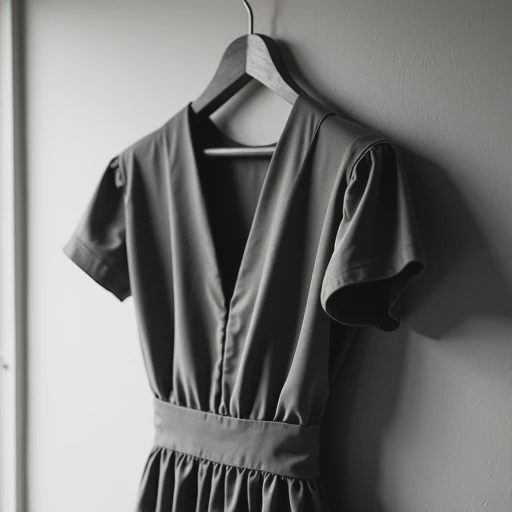
If the strong shoulder was the frame, the soft waist was the focal point. And the word "soft" here is crucial.
When I talk about a soft waist, I don't mean a waist that's been cinched into submission. I mean a waist that's been indicated rather than enforced. Vintage garments from the 1940s, in particular, often achieved this through cut rather than constriction. A dress might have gentle gathers at the waistline instead of tight darts. A blouse might be tucked loosely into a high-waisted skirt, creating a natural break without a belt cinched to the last notch. A jacket might have a shaped but not tight waist seam — fitted enough to show the body's natural curve, eased enough to let the fabric move.
This softness is what separates truly elegant vintage tailoring from the kind of structured reproduction that feels stiff. The body has its own softness. It breathes, it moves, it shifts throughout the day. A waist that's defined by a rigid, unyielding band of fabric looks correct on a mannequin and uncomfortable on a woman. A soft waist moves with the body's own rhythm. The definition is visible — clearly visible, in photographs and in person — but it comes from the way the fabric is cut and draped, not from aggressive tightening.
The camera loved this soft waist for a very specific reason: it created shadow. A defined but not compressed waist catches light differently above and below the waistline. The fabric curves inward, creating a subtle shadow at the narrowest point. In a black-and-white photograph, that shadow is the difference between a body that looks dimensional and a body that looks like a flat column. The soft waist gave the camera something to work with — a point of visual interest, a rhythm of light and dark, a sense that the woman inside the clothes was a three-dimensional person. Modern stretch clothing, which skims the body without defining it, eliminates this shadow. The torso becomes a continuous, unbroken plane. The camera has nothing to anchor on, and the photograph loses the structure that makes it compelling.
Why These Two Principles Worked Together
The strong shoulder and the soft waist were not separate techniques. They were a matched pair, designed to balance each other in a way that produced a silhouette greater than the sum of its parts.
Think of it as a visual sentence. The strong shoulder opened the statement — assertive, clear, confident. The soft waist answered it — receptive, curved, human. Without the strong shoulder, the waist had nothing to play against; the silhouette became shapeless. Without the soft waist, the shoulder became aggressive; the silhouette became harsh. Together, they created a proportion that was simultaneously commanding and approachable. And that proportion, when captured on film, read as what we now call timeless.
This pairing also solved a problem that every woman who's ever been photographed understands intuitively: the problem of looking simultaneously grounded and graceful. The strong shoulder anchored the upper body. It gave the photograph a sense of stability — a woman who wasn't about to be blown over by the nearest breeze. The soft waist provided movement and life beneath that anchor. It suggested breath, softness, a body that existed in time and not just in architecture. The combination is what makes a woman in a 1940s photograph look like she belongs exactly where she is — not posing, not performing, just present.
How I Use These Principles Now (Without Dressing Like a Period Piece)
I am not trying to dress like a 1945 film still. I live in Brooklyn in 2026. I ride the subway. I sit in cafés. I walk long blocks in weather that doesn't cooperate. But I think about the soft waist and the strong shoulder every time I get dressed, because they're not period details. They're structural tools, and they work on any body, in any decade.
On the shoulder: I look for jackets and coats with a defined shoulder seam that sits at the actual edge of my shoulder, not somewhere halfway down my upper arm. I look for set-in sleeves rather than dropped shoulders when I want to feel polished. I've learned that even a lightweight vintage blouse with a tiny puff at the shoulder cap can create the same framing effect as a padded jacket — just in a gentler register. When I try something on, I check the shoulder line in the mirror from the side. If it reads clearly, I know the rest of the outfit will have a foundation. If it slumps, I know I'll feel unformed all day.
On the waist: I don't belt everything. I used to. I thought a belt was the only way to create a waist. Now I look for pieces that do the work themselves — a dress with gentle front gathers, a high-waisted skirt that sits at my natural waist without a belt loop in sight, a cardigan that nips in slightly at the ribcage and then releases. The softness is the point. I want the definition, but I want it to feel like it happened naturally rather than being imposed. When I do wear a belt, I wear it looser than I used to — just enough to suggest the waist, not enough to divide my body into two separate halves.
The camera isn't the point of any of this. Most days, no one is photographing me. But the principles hold because what the camera rewarded — clarity, balance, proportion, the interplay of structure and softness — are the same things the human eye registers as beautiful, whether or not it knows why. A woman walks into a room with a defined shoulder and a soft waist, and people notice. Not the clothes, necessarily, but the composition. The way she holds space. The way the body and the garment have come to an agreement.
Old clothes photographed well because they were designed with an understanding of how a body occupies three-dimensional space and how a camera collapses that space into two. The strong shoulder gave the camera a clear line to read. The soft waist gave it a shadow to follow. Together, they created photographs that still hold our attention decades later — not because the women in them were more beautiful than we are, but because their clothes understood what a camera needs.
The good news is that none of this is lost. The vintage pieces with these qualities are still out there, hanging in thrift shops and vintage stores, waiting for women who know how to look for them. And the principles themselves — a defined shoulder, a soft waist, a silhouette built on balance — are free. You don't need a 1940s label to use them. You just need to know what you're looking at, and why it works, and how it might work on you.
Style should feel collected, not crowded. And sometimes, the best way to dress for the life you're living now is to borrow a little structural wisdom from a photograph taken eighty years ago.

No letters yet — be the first to write.