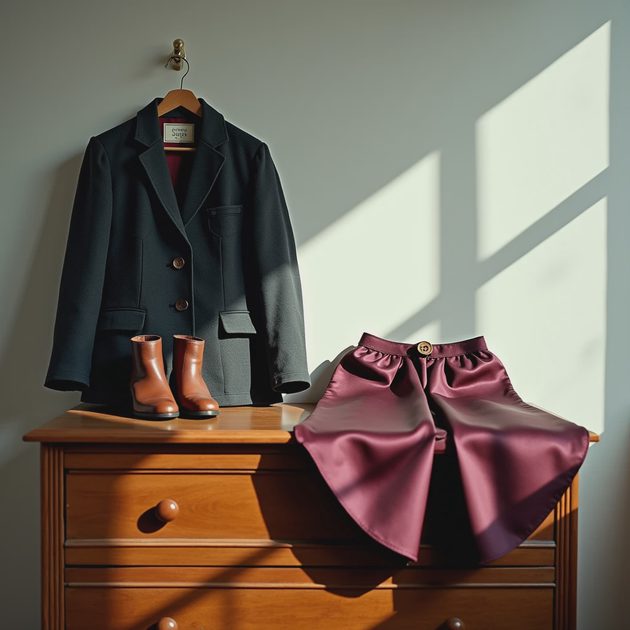
At first glance, the 1940s and the 1970s have nothing to say to each other. The 1940s are shoulder pads and seamed stockings and waistlines defined by rationing as much as by Dior. The 1970s are bell sleeves and maxi skirts and a softness that looks, in photographs, like it smells of incense and autumn leaves. One decade is structured. The other is fluid. One is about holding together. The other is about letting go.
I used to think of these two decades as opposites — and in many ways, aesthetically, they are. A 1942 suit and a 1976 peasant dress do not belong in the same outfit, or the same mood, or the same story. But the longer I study vintage clothing, the more I see a shared thread running beneath the surface differences. Both decades, at their best, produced a kind of femininity built on capability rather than decoration. Both decades understood that women's clothes needed to move, to function, to work with a life rather than just framing a body. And both decades, in their own language, said the same quiet thing: a woman who can move through the world on her own terms is more beautiful than a woman who is simply looked at.
This essay is about that thread — the invisible line connecting the shoulder-padded 1940s to the unstructured 1970s. It's not a history lesson. It's a way of seeing, and a way of dressing, that I return to every time I stand in front of my closet.
The 1940s: Femininity as Capability
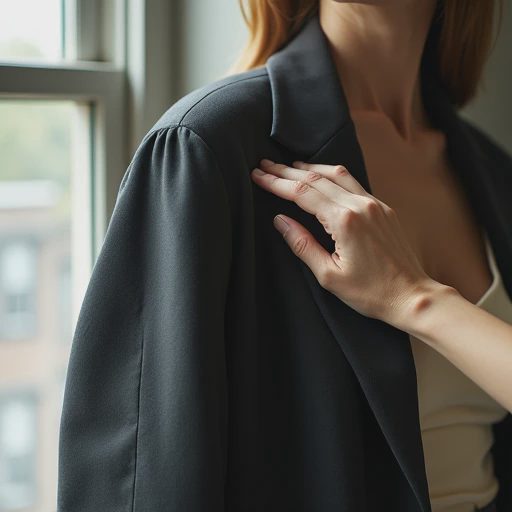
When we talk about 1940s fashion, the story usually starts with the war. Fabric rationing. Utility clothing. Women entering the workforce in unprecedented numbers. The shoulder pads that had been borrowed from menswear in the late 1930s became standard, not because they were fashionable but because they projected strength. Clothes had to work. They had to survive factories and offices and bicycle commutes and nights in air-raid shelters. A dress that was merely pretty was not enough.
Out of those constraints came a particular kind of femininity — one I've come to think of as capable femininity. The silhouettes were structured but never rigid. The waists were defined but never cinched to the point of immobilization. The skirts were full enough to walk in, narrow enough to avoid catching in machinery. The fabrics were sturdy — wool gabardine, cotton twill, rayon crepe — and they were cut with precision because there wasn't fabric to waste on mistakes.
Look at photographs of women in the 1940s, and what strikes you is not glamour. It's composure. A woman in a 1940s suit looks like she can handle whatever the day brings — a shift change, a telegram, a walk across the city in the rain. The clothes are elegant, but the elegance is a byproduct of function, not the goal. The goal was: can you move in it? Can you work in it? Can you live in it?
This is the 1940s lesson I carry into my own dressing now: femininity that disables you is not femininity. It's ornament. A sleeve that won't let you reach for a book. A waist that won't let you take a deep breath. A skirt that won't let you climb stairs. The women of the 1940s rejected these limitations not because they rejected beauty, but because they needed their bodies to function in the world. Beauty had to accommodate function, or it wasn't beautiful enough to keep.
The 1970s: Femininity as Freedom
The 1970s arrived at a similar conclusion from the opposite direction. Where the 1940s built structure around a woman and called it strength, the 1970s removed structure and called it liberation. The waist disappeared. The shoulder pads softened or vanished entirely. The fabrics became fluid — jersey, challis, crepe de chine, suede, crochet. A woman in a 1970s outfit didn't look composed. She looked comfortable. At ease. Unbothered by the male gaze or the fashion establishment or the rules that had governed women's bodies for decades.
But here is the thing I've come to understand: this ease was not the absence of intention. It was the presence of a different intention. The 1970s woman — the one I picture when I watch old photographs of Ali MacGraw or Lauren Hutton or the anonymous women in street-style shots from the era — dressed for herself. Not for an institution. Not for a husband. Not for an office dress code. She dressed for comfort, for movement, for the particular pleasure of feeling fabric move against bare skin.
This, too, is a kind of capable femininity. It's not capable in the 1940s sense of being ready for the factory or the air-raid warden's post or the widow's walk. It's capable in the sense of being ready for a life that belongs to you. A woman in a 1970s maxi skirt and a soft cotton blouse can sit cross-legged on the floor. She can walk barefoot through grass. She can drive a car, board a plane, hold a baby, cook a meal, make love, get up the next morning and do it all again. The clothes don't stop her. They move with her. They serve her pleasure instead of demanding her performance.
The 1970s lesson I carry: comfort is not the enemy of beauty. Comfort, chosen intentionally, is a form of self-respect. A woman who insists on being comfortable in her clothes is a woman who values her own experience over the opinions of observers. That value system — experience over observation — is the quiet feminist thread that runs through both the 1940s and the 1970s, even though they looked nothing alike.
The Shared Thread: Clothes That Serve the Life
So what do these two decades actually share, beneath the surface differences of silhouette and fabric and mood?
Movement.
Both decades, in their own way, prioritized clothes that a woman could move in. The 1940s did it through precise tailoring — a well-cut sleeve, a skirt with walking ease, a jacket that didn't pull across the back when you reached forward. The 1970s did it through fluidity — bias cuts, stretch fabrics, loose weaves, open necklines. The methods were different, but the value was the same: a woman's body is a body in motion, and clothes that ignore motion are clothes that fail.
Pockets.
This sounds trivial, but it isn't. The 1940s put pockets in everything — suits, dresses, skirts, coats. Women needed to carry things. Handbags weren't always practical, and a woman on a factory floor or a bicycle or a crowded street needed her hands free. The 1970s, in its own way, continued this — trousers with deep pockets, jackets with patch pockets, skirts with hidden seams. Pockets are the smallest, quietest signal that a garment was designed for a woman who does things rather than a woman who is looked at.
The absence of performance.
Neither decade's best clothes asked a woman to perform. The 1940s suit said: I am competent. The 1970s maxi dress said: I am at ease. Neither said: look at me. The looking was secondary. What mattered first was the living.
The Decades I Skip, and Why
I want to pause here and talk about the decades I don't reach for as often, because the contrast sharpens the point.
The 1950s, for all their beauty — and they were beautiful, genuinely, with their full skirts and tiny waists and perfect hourglass proportions — often produced a femininity that was more about decoration than capability. The clothes were gorgeous, but they demanded a body that conformed to them rather than accommodating the body that lived in them. The waist was cinched. The heels were high. The skirt required a petticoat. The whole silhouette was designed to be looked at, and the woman inside it was, in some sense, secondary to the shape she made.
I still wear 1950s pieces. But I wear them selectively, and I almost always pair them with something grounding — a 1950s full skirt with a plain cashmere sweater and flat boots, not with the matching fitted cardigan and the heels and the pearl earrings. I edit the performance out. I borrow the silhouette and leave the context behind.
The 1960s, particularly the early 1960s, have a similar tension. The Jackie Kennedy suits, the pillbox hats, the matching accessories — these were clothes designed for a woman whose life involved a certain kind of public visibility. They're beautiful, but they're formal in a way that doesn't always translate to the life I live. When I reach for 1960s pieces, I reach for the later years — the softening hemlines, the relaxed shifts, the years when women began to dress for themselves again.
What I've realized is that I'm drawn to decades that dressed women for action — not for display, not for status, not for the pleasure of being looked at. The 1940s and the 1970s, for all their differences, share that fundamental orientation. And that's the orientation I want my own wardrobe to have.
How I Wear These Two Decades Now
I don't dress exclusively from the 1940s and 1970s. My closet spans decades, and some of my favorite pieces are from the years I just criticized. But the philosophy I reach for — the filter I use when I'm standing in a thrift shop or in front of my own closet — comes from these two eras.
From the 1940s, I take structure. A jacket with a defined shoulder. A skirt with a waistband that sits at my natural waist. Trousers with pleats that allow movement. These are the pieces that make me feel composed, capable, ready for whatever the day asks. They're the armor — not hard armor, but the kind of armor that reminds your body to stand up straight and take a deep breath.
From the 1970s, I take softness. A bias-cut silk skirt that moves like water. A cardigan so worn it's lost its shape. A blouse with an open neckline that doesn't require a specific bra. These are the pieces that make me feel at home in my body — not held together, but held. They're the release — the exhale after the structured inhale, the ease after the composure.
Most of my outfits now are a conversation between these two impulses. A 1940s jacket over a 1970s silk camisole. A 1970s maxi skirt with a 1940s-style fitted sweater. The structure and the softness, the capability and the ease, the woman who can handle things and the woman who knows when to stop handling and just be. That's the balance I'm chasing. It's the balance these two decades, together, taught me to see.
Style should feel collected, not crowded. And the collection I'm building, slowly and over years, is a collection of pieces that serve a woman in motion. The 1940s gave me the structure to stand steady. The 1970s gave me the softness to move freely. Together, they gave me the questions I ask every time I get dressed: Can I move in this? Can I live in this? Does this serve my life, or just my reflection?
A woman who can answer yes to all three — whether she's in a tailored suit or a flowing dress, whether she's walking into a boardroom or onto a beach — is a woman dressed in the shared language of two decades that understood something true. Femininity, at its most enduring, is not a look. It's a relationship between a body and the clothes that set it free.

No letters yet — be the first to write.