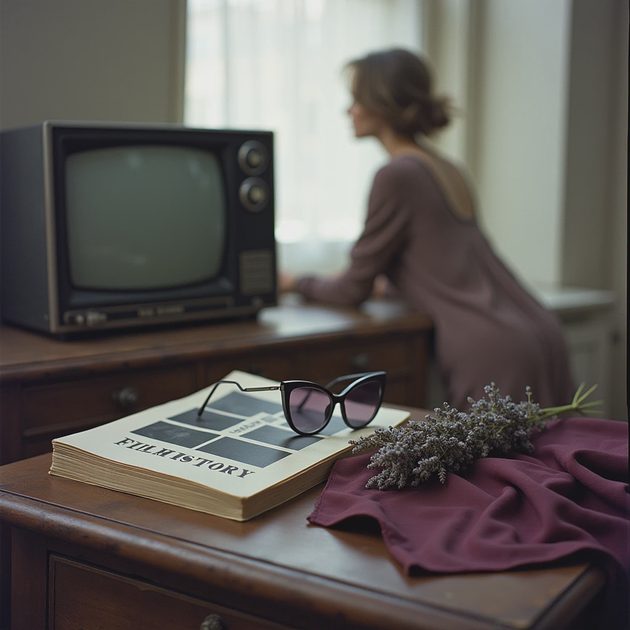
I have a confession. There was a period in my early twenties when I dressed like I was waiting for the cameras to roll. Not literally — I wasn't walking around in period costumes — but I was dressing with a kind of cinematic expectation. Every outfit was a reference. Every silhouette was a quote. A skirt from a Godard film. A blouse from a Hitchcock blonde. A coat that belonged on a French New Wave heroine, not on a woman taking the L train to a temp job in Midtown.
The problem wasn't the clothes. The clothes were beautiful. The problem was the translation. I was dressing like I was in the movie, not like a woman who had seen the movie and absorbed something from it into her actual life. And there is a difference — a visible, palpable difference — between those two things.
Learning to dress like you love old movies, without looking like you're about to be called to set, is an art. It's the art of borrowing mood instead of costume, silhouette instead of script, one detail instead of the entire production. This essay is about how I learned to do that, and the principles I return to when I want my outfit to nod at cinema without bowing to it.
The Rule of One: Borrow One Element, Not the Whole Frame
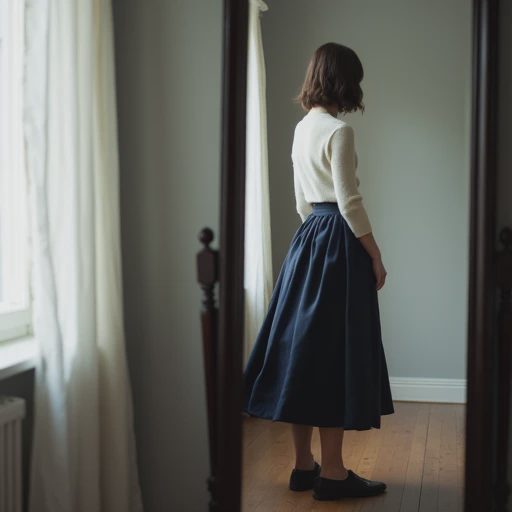
The most common mistake I made, and the one I see most often in other women who love cinematic style, is borrowing too much at once. A 1950s full skirt with a fitted cardigan, pearl earrings, cat-eye sunglasses, and a structured handbag is not an outfit. It's a still from a Douglas Sirk film. It's beautiful, but it's a costume — not because any single piece is wrong, but because there's no breathing room. No gap where the real woman, the one living in the present, can enter.
The rule I follow now is: one cinematic element per outfit. One piece, one gesture, one proportion that carries the reference. Everything else stays grounded, simple, modern enough to remind the world — and myself — that I'm not in character.
What does that look like in practice?
A 1940s bias-cut skirt in liquid silk with a plain cashmere sweater and flat leather loafers. The skirt carries the cinematic weight. The sweater and shoes are just clothes.
A pair of high-waisted 1950s trousers with a white cotton T-shirt and an unremarkable trench coat. The trousers do the referencing. The rest of the outfit is neutral.
A 1960s box-shoulder jacket in pale tweed over jeans and a silk camisole. The jacket is the star. Everything else is the supporting cast.
What you're doing, with this one-element approach, is giving the cinematic piece space to breathe without letting it dominate the entire frame. The reference is clear to anyone who's paying attention, but it doesn't demand attention. It's an invitation, not an announcement.
Mood Before Costume: Translating Emotion Instead of Replicating Looks
A film wardrobe is not just a collection of clothes. It's a visual language for a character's inner life. The clothes tell you who she is, what she wants, what she's afraid of, what she's trying to hide. When I watch old movies now, I try to pay less attention to the specific garments and more attention to the emotional register they create.
Ingrid Bergman in Notorious wears a series of impeccably tailored suits and evening pieces that communicate containment — a woman holding herself together. The wardrobe is beautiful, but what makes it memorable is the tension between the polished exterior and the roiling interior. You could replicate the exact suit, but if you don't understand the containment she was projecting, the outfit won't carry the same weight.
Katharine Hepburn in The Philadelphia Story wears high-waisted trousers and relaxed blouses that communicate independence and physical freedom — a woman who moves through the world on her own terms. The specific trousers matter less than the attitude of the silhouette, which is: I am not here to be looked at. I am here to be.
The practical question I ask myself now is not "What was she wearing?" but "What was that outfit making me feel?" If a film character's wardrobe communicates ease, I look for pieces in my own closet that make me feel at ease — not necessarily the same decade or cut, but the same emotional quality. If it communicates containment, I reach for structure. If it communicates romance, I reach for softness and movement. The reference is emotional before it's visual. That shift — from copying the look to understanding the mood — is what separates cinematic dressing from costume dressing.
Silhouette as Signature: The Bridge Between Screen and Street
If I had to name the single most transportable element from old movies into real-life dressing, it would be silhouette. Not specific garments. Not exact decade reproductions. Silhouette — the outline of the body, the proportion between shoulder and waist and hem, the way the clothes shape the space a woman occupies.
Old movies are a masterclass in silhouette clarity. The best costume designers — Edith Head, Givenchy for Hepburn, Adrian in the 1930s, Theadora Van Runkle in the late 1960s — understood that a film camera flattens three dimensions into two, and that silhouette is what survives that flattening. A character's outline needed to read instantly, even in a wide shot, even in black and white, even when she was moving through a crowded scene.
This is why vintage film costumes often look more striking than modern clothing in photographs. The silhouette was intentional. It wasn't an afterthought. It was the first thought, and the details followed.
The way to borrow this for real life is to think about your own silhouette before you think about color, print, or accessories. When I'm putting together an outfit that I want to feel cinematic, I start with the outline. What shape am I making? Where is the narrowest point? Where is the widest? Is the shoulder defined or soft? Is the waist present or absent? Is the hem narrowing or flaring?
A few silhouette formulas I return to, all borrowed from film and translated for real life:
The Strong Shoulder + Soft Waist, from 1940s films: a jacket with a defined shoulder line, over a dress or blouse with gentle waist gathering. Structured on top, fluid below. This silhouette reads as composed without reading as rigid.
The Long Line + Narrow Hem, from late 1960s cinema: a column of fabric — a long cardigan, a slim skirt, a dress without a waist seam — that elongates the body without constricting it. Faye Dunaway in The Thomas Crown Affair, Julie Christie in Petulia.
The Full Skirt + Fitted Top, from 1950s films, but done with restraint: the skirt has volume, but the top is a simple knit or a tucked-in silk blouse, no petticoat, no fuss. The proportion is the statement. The pieces themselves are quiet.
None of these require vintage pieces. You can find a strong-shouldered blazer at a contemporary store. You can find a bias-cut skirt from a modern brand. What makes the silhouette cinematic isn't the era of the pieces. It's the clarity of the shape.
Accessories: The Smallest Signal, Not the Loudest
I used to think that accessories were where you could really lean into cinematic dressing — a beaded bag, a pair of opera gloves, a feathered hat. What I've learned is that accessories are where cinematic dressing most often goes wrong.
A single, small accessory that carries a film reference can be beautiful and personal. A silk scarf knotted at the neck the way Anna Karina wore hers in Band of Outsiders. A pair of sunglasses with a shape borrowed from Breakfast at Tiffany's. A locket on a chain, worn close to the throat, something a Hitchcock heroine might have received in a scene that was cut. These small gestures read as personal style, not performance, because they're intimate and understated.
What doesn't work: the head-to-toe accessory assault. The matching hat, gloves, bag, shoes, and jewelry that reads as "I'm playing a role." The opera gloves with a cocktail dress for a dinner that is not, in fact, an opera. The feathered fascinator for a brunch that is not, in fact, a royal wedding. Context matters, and cinematic accessories are particularly sensitive to context. A piece that would look extraordinary in a film frame can look absurd in a neighborhood café.
My rule: if the accessory would make sense in a close-up, it works. If it only makes sense in a wide shot — if it needs the whole frame, the whole outfit, the whole context to justify itself — it's too much. A silk scarf at the neck works in a close-up. A pair of opera gloves requires the wide shot, and real life is mostly close-ups.
The Final Filter: Would You Wear This If You'd Never Seen the Movie?
This is the question I ask myself when I'm standing in a fitting room with a piece that feels thrillingly cinematic. Would I love this jacket if I'd never seen the film I'm picturing? Would this skirt still make sense in my closet if the movie reference were stripped away?
If the answer is no — if the piece has no life outside the reference — it's a costume piece. It's a prop. It's something you're buying for the fantasy of the film, not for the reality of your life.
If the answer is yes — if the piece is beautiful and wearable and right for your body, regardless of which actress wore something similar in 1962 — then the cinematic reference is a bonus. It deepens the piece without defining it. It gives the garment a story without trapping it in someone else's.
The pieces I've kept longest are the ones that passed this test. A navy silk crepe dress that reminds me, faintly, of something Grace Kelly might have worn, but that I wear to gallery openings and dinner with friends and feel entirely like myself. A pair of high-waisted trousers that nod at Katharine Hepburn but spend most of their life on the subway. A trench coat that could have been in a dozen films but has been, for three winters, simply my coat.
Dressing like you love old movies is one of the great pleasures of vintage style. The films are a bottomless resource — for silhouette, for mood, for proportion, for the way a hem can swing or a collar can frame a face. But the films are a starting point, not a script. The goal is not to recreate a frame. The goal is to absorb the feeling of the frame and translate it into your own life.
Style should feel collected, not crowded. And the best cinematic dressing isn't a collection of props. It's a collection of pieces that carry a private, personal reference — visible only to you, or to the one person at the party who also loves that film. You see her across the room. She sees you. No one else knows what's happening. But the two of you, in your quiet, un-costumed, deeply cinematic outfits, understand each other perfectly. That is the art. The reference is shared, but the clothes are your own.
No letters yet — be the first to write.