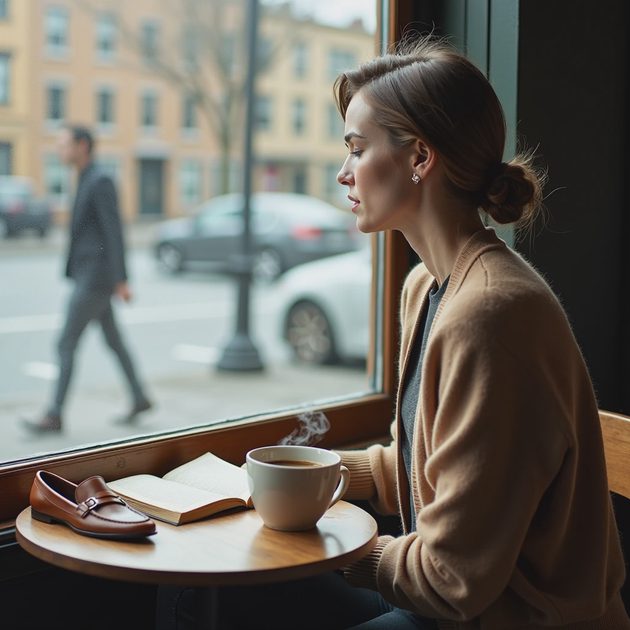
There is a café three blocks from my apartment. I go there often enough that the barista knows my order — a small oat milk cappuccino, sometimes a croissant if it's been a long morning — but not so often that anyone would notice if I skipped a week. It's the kind of place where the tables are slightly too small, the music is never quite right, and the light through the front window catches the steam from the espresso machine in a way that makes every morning feel slightly cinematic. I love it.
A café like this is a quiet test of personal style. Not a big test. Not a gallery opening or a dinner party or a first date. Just the small, unremarkable test of walking three blocks, sitting at a table with a book for an hour, and feeling like the clothes you put on belong to the person you are. No performance. No costume. Just yourself, on an ordinary morning, in a familiar place.
This is the outfit I reach for on those mornings. Not always the exact same pieces, but the same formula — the same feelings, the same soft architecture. Here is what I wear, why I chose each layer, and what I've learned about dressing for the smallest, most honest outings.
The Formula That Replaces a Uniform
I don't have a uniform. I've tried — I love the idea of a single, repeatable outfit system that removes all friction from the morning. But my mood changes too much, the weather changes too much, and frankly, I get bored. What I have instead is a formula: a quiet set of parameters that narrow the choices without eliminating them.
For a neighborhood café morning, the formula looks like this:
One soft layer.
Usually a cardigan or a fine-gauge sweater, something that can be unbuttoned or removed if the café is overheated, something that feels like a small hug when I step outside into the morning air.
One pair of trousers that move.
Not jeans, which I find too stiff for sitting and reading. Not a skirt, which on a chilly morning requires tights and a whole set of additional decisions. Wide-leg wool trousers, or soft cotton twill, or a relaxed vintage crepe pair with an elastic waist — the kind of trousers you can sit cross-legged in if the café has an armchair.
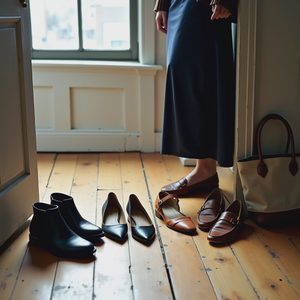
One pair of shoes that belong to the block.
Flats or low boots, broken in, quiet-soled. Shoes I can walk in without thinking, shoes I can slip off slightly under the table without anyone noticing.
One small, meaningful detail.
A silk scarf at the neck, a vintage brooch pinned to the cardigan, a ring that belonged to someone else once. A detail that has no function except to make me feel like I showed up for myself.
That's it. Four elements, infinite variations. The formula is loose enough to accommodate mood and weather, but tight enough that I never stand in front of my closet for ten minutes feeling like I have nothing to wear. On a café morning, the formula does the work so I can save my thinking for whatever I'm reading.
The Cardigan That Started It All
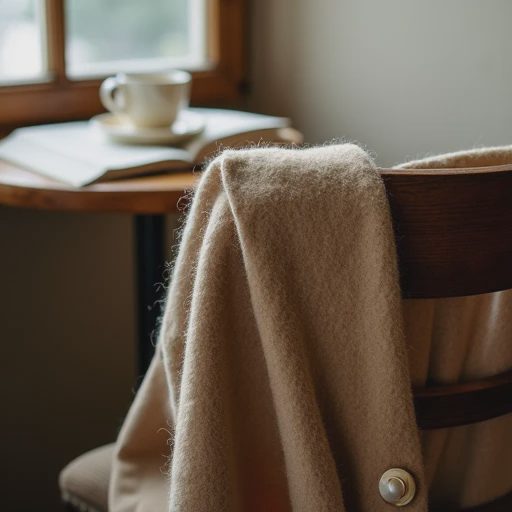
The soft layer I reach for most often is a 1950s cashmere cardigan in a shade of fawn brown that doesn't photograph particularly well but looks, in person, like the color of coffee with too much cream. I found it at an estate sale in Queens three years ago, folded neatly in a drawer of old sweaters, priced at fifteen dollars. It had clearly been worn and loved and washed carefully by someone who understood cashmere. The mother-of-pearl buttons are original, though one has a tiny chip near the edge. The ribbing at the cuffs is slightly relaxed, the way cashmere gets after decades of being pushed up over someone's wrists.
It is not a statement piece. It is not the kind of cardigan anyone would stop me on the street to compliment. But I reach for it constantly — more than any other garment I own — precisely because it refuses to be the center of attention.
What this cardigan does, and what I look for in any café-morning layer, is frame the outfit without defining it. It sits close to the body but not tight. It skims the waist without cinching. It can be worn open over a silk blouse or buttoned up as a top on its own. It's the kind of piece that makes other pieces look better — softens a structured trouser, grounds a delicate necklace, makes an otherwise plain outfit feel considered.
I've bought and donated at least a dozen cardigans since finding this one. None of them did what this one does. The difference, I think, is that I bought those other cardigans because they looked like something. I kept this one because it feels like something. When I put it on, my shoulders drop slightly. My posture relaxes. The cardigan doesn't demand I become a version of myself that looks good in a cardigan. It meets the version I already am, on a sleepy Tuesday morning, before I've finished my coffee.
The Trousers That Understood the Assignment
On bottom, I wear a pair of wide-leg wool trousers in a dark brown that's nearly charcoal. They're vintage, probably late 1940s, with a high waist, deep pleats at the front, and a cut that widens gently from the hip to the hem. I found them at a thrift shop in Greenpoint last winter, and they've become the backbone of my casual outfits in a way I didn't expect.
What makes these trousers work for a café morning is everything they don't do. They don't pinch at the waist when I sit for an hour. They don't lose their crease or wrinkle into a mess the moment I cross my legs. They don't require a belt, though I sometimes wear one anyway — a thin leather one in dark brown, worn soft, that I buckle loosely enough to leave a finger's width of breathing room.
They also move beautifully. I've learned that trousers you plan to sit in for any length of time need a certain amount of ease in the hip and thigh. Too fitted, and by the time you stand up to leave, the fabric has pulled and creased in unflattering places and you feel rumpled rather than relaxed. These trousers have enough width to gather softly when I sit, and enough weight to fall back into place when I stand. They're forgiving without being sloppy. That's a difficult line, and it's one of the reasons I return to vintage trousers again and again — they were often cut with this kind of seated ease built in, because women in the 1940s and 1950s sat at desks and on trains and in library chairs, and their clothes were expected to survive it.
The Shoes That Walk Three Blocks Without a Second Thought
The shoes are the simplest part of the outfit and, in some ways, the most important. A café morning involves walking — not far, probably less than a mile round trip, but enough that the wrong shoes will announce themselves by the time I reach the front door. A pinched heel. A stiff sole. A strap that looked fine at home and starts rubbing halfway down the first block. I've learned to respect the walk.
I wear a pair of brown leather loafers — vintage, 1980s, made in Italy, found at a consignment shop in Park Slope for thirty dollars. They have a low stacked heel, a rounded toe, and the kind of thin, flexible leather sole that bends with my foot rather than fighting it. They slip on and off without laces or buckles, which means I can tuck my feet up under me on the café armchair without a production. They're polished enough to read as intentional but casual enough to belong to a woman who walked to get there.
The shoes matter for another reason, too. In an outfit built around softness and ease — a relaxed cardigan, wide trousers, gentle layers — the shoes anchor the look. They tell the world you haven't given up. A pair of slippers or worn-out sneakers with this same outfit would tip it into "I didn't try." The loafers say "I tried, but gently." That distinction is the quiet heart of neighborhood dressing.
What It Feels Like to Wear This Outfit
The first time I wore this exact combination — the fawn cashmere cardigan, the wide brown wool trousers, the leather loafers, and a small gold locket tucked under the collar — I walked into my café and the barista looked up and said, "You look nice today." Not in a way that suggested I usually looked terrible. Just in a way that suggested I looked like myself, but more so.
That, I think, is the goal.
This outfit doesn't ask me to perform. It doesn't announce itself. It doesn't read as vintage in a way that invites commentary or costume comparisons. It reads as a woman who knows what she likes, who has kept her favorite pieces close, who dressed for the morning rather than for an audience. When I sit at a small table by the window with my cappuccino and my book, I'm not thinking about my clothes. I'm thinking about what I'm reading, or what I need to write later, or whether the croissant is slightly better than it was last week. The clothes have done their job and receded. They've made me feel grounded without making me think about why.
That's what I want from every café outfit. Not to look a certain way. Not to be noticed or admired or photographed for a street style roundup that doesn't exist. I want to walk three blocks, sit at a familiar table, and feel completely at ease in the body I'm in and the clothes I've put on it. That's the quietest, deepest confidence there is — and it starts, on an ordinary morning, with a cardigan that feels like a friend and trousers that let you sit however you want.
Style should survive real life. Not just the big occasions — the weddings, the gallery openings, the evenings that call for silk and a steady hand. But the small ones. The café mornings. The solo afternoons. The hours spent reading in a corner with a coffee going cold because you're too absorbed to notice. These are the moments that add up to a life, and the clothes we wear for them should feel like ours.
This outfit is mine. No performance, no costume, no second-guessing in the hallway mirror. Just a woman in a cardigan, walking three blocks, about to order the same thing she always orders. And feeling entirely, quietly, like herself.
No letters yet — be the first to write.