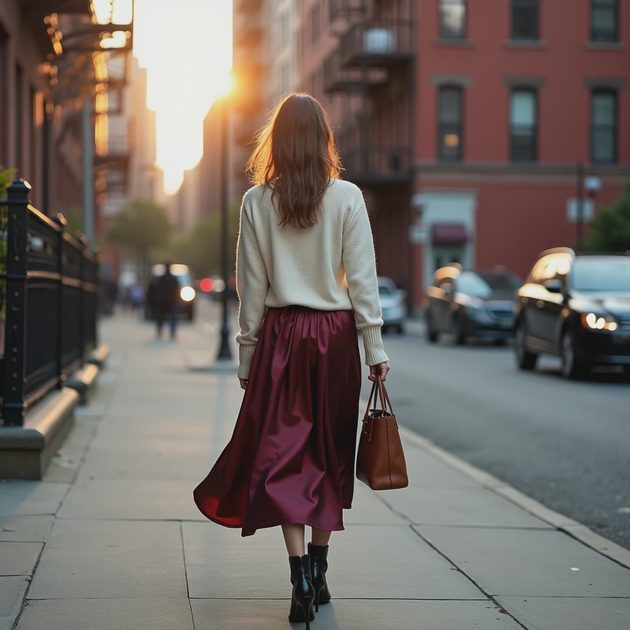
There is a moment that happens about half a block from my apartment, every time I wear something particularly romantic. I catch my reflection in a car window or a shopfront and think: is this too much? The full skirt. The silk blouse. The scarf at the neck. For a split second, I see myself the way I imagine a stranger might see me — as a woman who dressed for an occasion that doesn't exist, who wandered out of a period film and onto Flatbush Avenue.
Most of the time, the feeling passes. I adjust the scarf, or unbutton the cardigan, or remind myself that no one is actually looking at me with the critical eye I'm turning on myself. But the feeling is real, and I've learned to pay attention to it. It tells me when an outfit has tipped slightly out of balance — when the romance has overwhelmed the reality, and the woman underneath the clothes has started to disappear.
Dressing romantically in a city is a negotiation. The city is hard edges and fast pace and crowded trains and dirty sidewalks. Romance is softness and delicacy and a certain slowness of spirit. Put them together without care, and the city wins — the outfit feels like a costume, or a protest, or a misunderstanding of where you actually are. But put them together with intention, and the contrast becomes the point. The soft blouse against the brick wall. The silk scarf against the subway tile. The wool skirt moving through the crowd like a quiet thought in a loud room.
Here is how I find that balance, piece by piece.
The Rule of One Soft Piece
The single most useful guideline I've found for romantic dressing in the city is this: one soft piece per outfit, and everything else grounded. It sounds simple. It is simple. But it took me years of overdoing it — wearing the lace blouse with the full skirt with the velvet shoes with the beaded bag — to understand that romance in clothing doesn't accumulate. It dilutes. Too many soft pieces in one outfit, and none of them read. The eye doesn't know where to land. The woman disappears into the fabric, and all anyone sees is an idea of femininity rather than a person wearing clothes.
One soft piece, by contrast, stands out. A silk blouse with worn-in jeans and leather loafers. A full midi skirt with a plain cashmere sweater and flat ankle boots. A lace-trimmed camisole under a structured blazer with wool trousers. The romantic piece becomes the focal point, and the grounded pieces around it do two things: they keep the outfit tethered to reality, and they make the romantic piece look more beautiful by contrast.
This rule applies especially to vintage. Vintage romantic pieces — a 1940s bias-cut skirt, a 1950s lace collar, a 1930s silk blouse with covered buttons — carry a visual weight that modern romantic pieces don't. They read as more intentional, more special, more potentially costume-like. Pairing a single vintage romantic piece with modern or neutral basics is the fastest way to bring it into the present tense. It says: I love this skirt, but I also take the subway. I found this blouse at a thrift shop, but I'm wearing it to a coffee meeting, not a garden party.
Fabric That Whispers Instead of Announcing
Part of feeling overdone is wearing fabric that demands attention. Shiny satin. Stiff tulle. Lace that scratches. Velvet in broad daylight. These fabrics are beautiful in the right context — evening, occasion, a room with low lighting and a reason to dress up — but on a Tuesday afternoon, on a city street, they can feel like they're trying too hard.
The fabrics that carry romance without overdoing it are the ones that whisper. Matte silk crepe de chine instead of glossy charmeuse. Fine cotton voile instead of stiff lace. Lightweight wool jersey instead of heavy velvet. Rayon challis with a soft drape instead of taffeta with a rustle. These fabrics move with the body rather than standing apart from it. They absorb light rather than reflecting it. They read as romantic to anyone who's paying attention, but they don't announce themselves from across the street.
Texture matters more than shine. A matte silk blouse with a slight slub has more visual interest — and more romance — than a glossy polyester top with no texture at all. A brushed wool skirt catches light softly and changes in different angles. A cotton blouse with a subtle dobby weave feels special without feeling precious. These are fabrics you can wear all day without feeling like you're in eveningwear. They're romantic in the way a poem is romantic — through attention and detail, not through volume.
The Role of Color Restraint
Color is another place where romantic dressing can tip into overdone territory. A palette of blush pink, ivory, and soft lavender reads as undeniably romantic, but it can also read as sweet — and sweetness, in a city, can feel vulnerable in a way that doesn't always feel good. I learned this the hard way. I once wore a head-to-toe outfit in pale rose and cream — a silk blouse, a wool skirt, a pair of suede flats — and spent the whole day feeling like I was dressed for a bridal shower I hadn't been invited to. The outfit was beautiful on the hanger. On my body, on the subway, it felt like too much sugar and no salt.
I still wear those colors, but I don't wear them all at once. Now I pair a blush silk blouse with charcoal wool trousers. Or a cream cardigan with dark denim and brown leather boots. The darker, more grounded color anchors the soft one and keeps the outfit from floating away into pure confection. The romance is still there, but it's balanced — sugar and salt in proportion.
This also works with print. A floral blouse in muted tones — burgundy and navy and olive, not pink and lavender — reads as romantic without reading as precious. A paisley scarf in deep colors has the softness of a romantic accessory without the ingenue overtones. Vintage prints, particularly from the 1940s and 1970s, often use darker, earthier palettes that translate better to city life than the pastel-heavy prints of certain 1950s pieces. If you're drawn to romantic silhouettes but wary of looking too sweet, look for romantic pieces in deeper colors. The silhouette carries the romance. The color keeps it grounded.
Editing the Details: What to Remove Before You Leave
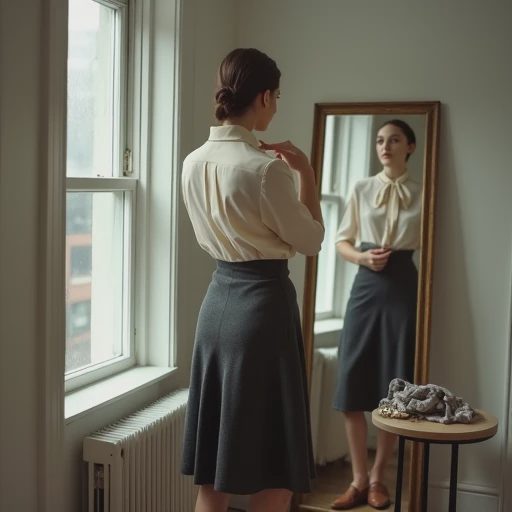
Here is a small practice that has changed the way I dress: before I leave the apartment, I look in the mirror and ask myself what I can remove. Not what I can add. Romantic dressing often invites accumulation — a necklace, a scarf, a brooch, a bracelet, a belt, a flower in the hair, a bag that matches the shoes. But romance, in real life, is better served by subtraction.
I look at myself and ask: is there one thing I can take off that would make the whole outfit breathe more easily? Sometimes it's the necklace — the neckline is doing enough on its own. Sometimes it's the belt — the waist of the dress is already shaped. Sometimes it's the scarf — the blouse has enough detail at the collar. Removing one element gives the remaining pieces more space. The outfit relaxes. It feels less composed and more alive, less like a still life and more like a woman about to walk out the door.
This is especially true of accessories. I wrote earlier about the rule of one soft piece. The same principle applies to romantic accessories. One scarf, or one brooch, or one pair of earrings. Not all three. An outfit with three romantic accessories reads as a collection. An outfit with one reads as a choice. The difference between "collected" and "crowded" lives in the editing.
Context Awareness: Dressing for the Real Day Ahead
The final piece of the puzzle has nothing to do with the clothes themselves and everything to do with the life they're about to enter. I've learned to dress for my actual day, not for an idealized version of it.
If I'm going to be on the subway, I don't wear a white silk blouse without a cardigan over it — someone will spill something, the seat will be questionable, and I'll spend the whole ride anxious instead of enjoying the outfit. If I'm walking more than a mile, I don't wear shoes that pinch, no matter how perfectly they match the skirt. If I'm going to a café where I'll be sitting in a deep armchair, I don't wear a skirt so full it requires two hands to gather. If it's windy — and in this city, it's often windy — I don't wear a skirt that flips up without a weighted hem or a pair of shorts underneath.
These adjustments are not compromises. They're the difference between wearing romantic clothes and living in them. A white silk blouse with a cardigan over it is still romantic. A midi skirt with flat boots is still romantic. A wool coat over a lace-trimmed dress is still romantic — more romantic, maybe, because the coat suggests a real woman in a real winter, not a fantasy woman in a climate-controlled dream. Context doesn't dilute romance. It deepens it. It gives the clothes a real day to move through, a real body to warm them, a real city to walk them home.
The city will not soften for your outfit. The subway will not become quieter, the sidewalks cleaner, the weather more cooperative, just because you're wearing something beautiful. But that's not a reason to stop dressing romantically. It's a reason to dress romantically with intelligence — with the rule of one soft piece, with fabrics that whisper, with colors grounded by something darker, with the discipline to remove one thing before you leave, and with an honest accounting of the day ahead.
Style should survive real life. And real life, in a city, is crowded trains and long walks and sudden rain and coffee spilled on the table and wind that finds every loose hem. Romantic dressing that can handle all of that — that can walk through the noise and still feel like a quiet, personal, deeply feminine choice — is romantic dressing that lasts. Not on the hanger. Not in the photograph. On the body, in the street, through the ordinary, beautiful, unglamorous day.

No letters yet — be the first to write.