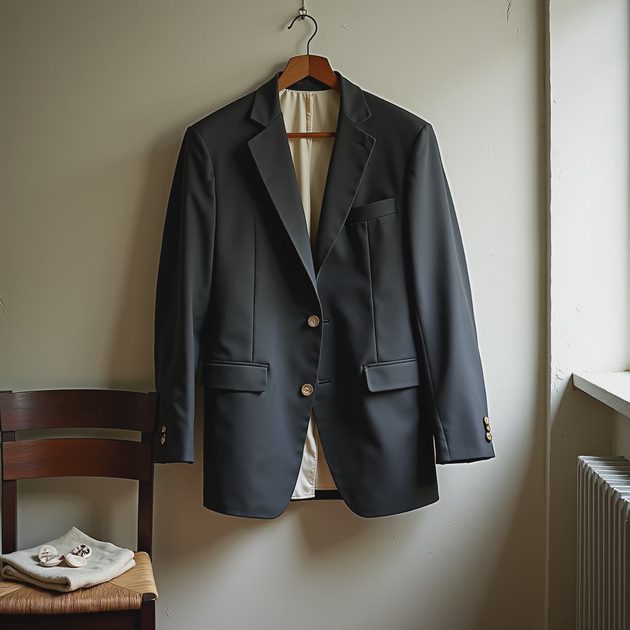
A good vintage blazer is one of the smartest things you can bring home from a thrift shop. It sharpens a soft dress. It grounds a romantic skirt. It makes jeans feel intentional. A bad vintage blazer, on the other hand, hangs in your closet for two years with the tags still attached while you tell yourself you'll tailor it someday. I know this because I've bought both kinds.
Over the years, I've developed a quiet checklist — the things I look at before I look at the price. Not after. Once you know a blazer fits beautifully across the shoulders or is lined in silk you didn't expect, the price becomes easier to justify. But if you fall in love with the idea of the blazer before you've checked its bones, you're shopping with hope instead of judgment. And hope, in a thrift shop, is expensive.
Here is exactly what I check first, every time.
The Shoulders: Where Everything Is Won or Lost
I start here because shoulders don't forgive. A waist can be taken in, sleeves can be shortened or lengthened, a hem can be adjusted — but shoulders are structure. If the shoulder seam doesn't sit where your actual shoulder ends, the blazer will never look like it belongs to you.
I check three things in quick succession.
First, I find the shoulder seam and press my thumb against it while the blazer is on the hanger. A seam that has been stretched out of shape or unevenly pressed is often a sign of poor storage or a garment that was worn past its limits. Neither is a dealbreaker, but both tell me something about the life the blazer has already lived.
Second, I try it on and lift both arms slightly — not a full reach, just the kind of movement you'd make reaching for a book or holding a subway rail. If the shoulder pad buckles or the sleeve head pulls dramatically, the cut isn't right for me, period. A blazer that only looks good standing still in front of a mirror is not a blazer for real life.
Third, I check the shoulder padding itself. Some vintage blazers have aggressive, stiff padding that reads very 1980s power-shoulder. Others have a softer, more natural line — think late 1940s or 1970s. I tend to prefer the softer ones, but the real question is whether the padding follows your shoulder or fights it. You'll know within seconds of putting it on.
The Lining: A Silent Quality Report
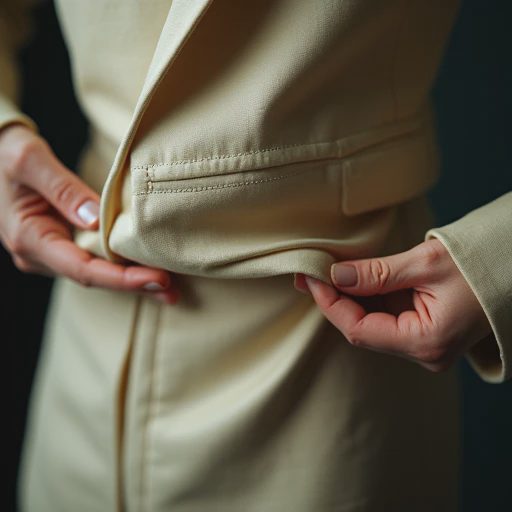
Nobody sees the lining but you, and that's exactly why it matters. The lining is where a blazer tells you its real story.
I turn the blazer inside out — completely — and look for four things.
Fabric content.
A silk or rayon lining breathes. A polyester lining traps heat and makes your arms feel like they're wrapped in plastic wrap by noon. Silk linings are surprisingly common in mid-century vintage blazers, and they're one of the quietest signs of quality. If I find one, my heart rate picks up slightly.
Seam integrity.
I run my thumb along the armhole seams and the side seams from the inside. Loose threads are fine. Gaping holes are not. If the lining is pulling away from the shell fabric in multiple places, the repair cost might outweigh the blazer.
Stains and discoloration.
Underarm stains on the lining are not always visible from the outside. If they're light and the blazer is otherwise perfect, I might still buy it — but I want to know before I'm standing in my own bedroom realizing it later.
The label, if there is one.
A union label, an old boutique tag, a script logo from a defunct department store — none of these guarantee quality, but they add texture and provenance. I keep a small mental collection of vintage labels I trust, and when I spot one, I smile.
If the lining is intact, breathable, and clean enough, the blazer has passed the second and most intimate test.
The Buttons: Small Details, Loud Signals
Buttons are the first thing a maker decided to spend money on or save money on, and they're remarkably honest about it.
I check whether the buttons are original. Mismatched buttons might mean the blazer was repaired by someone who cared, or it might mean the original buttons were lost and replaced hastily. If the replacements are beautiful — a set of carved mother-of-pearl on a wool blazer, for instance — I consider that part of the garment's story. If they're cheap plastic that doesn't match, I factor in the cost and labor of replacing them.
I gently tug each button to check how securely it's attached. A loose button is a fifteen-second fix at home. Three loose buttons might suggest the thread used throughout the garment was poor quality. Patterns matter in vintage clothing.
I count the buttons. Most blazers have two or three front buttons, and one of them — usually the top — will do the real work of closing the jacket. If the button stance (the height where the top button hits) falls at an awkward place on my torso, the blazer won't work with most of my wardrobe. A button that hits too high can make a blazer look prim. Too low can throw off the proportion of a skirt. There's a sweet spot, and I know it when I try it on.
Finally, I check for an extra button sewn inside. A spare button still attached to the inner seam is a tiny love letter from the maker. It tells me the garment was built to last. I'm disproportionately charmed by spare buttons. I admit this freely.
The Fabric: What It's Made Of and What It's Been Through
Now I look at the shell fabric itself, and I'm not just looking at fiber content. I'm looking at wear.
Wool in good condition has a slight spring when you press it. If a wool blazer feels stiff, flat, or papery, it's likely been dry-cleaned aggressively or stored poorly. Wool gabardine — common in 1940s through 1960s blazers — should have a smooth hand and a subtle sheen without looking shiny. Shine on a wool blazer is usually friction damage, not intentional luster, and it doesn't come out.
Linen blazers wrinkle beautifully. That's part of their charm. But check the elbows and the collar for thinning. Linen wears down in high-friction areas faster than wool, and once the fibers are compromised, they won't hold a mend.
Tweed and heavier wool blends hide a multitude of sins, which makes them excellent thrift candidates and also requires closer inspection. I run my hands down both sleeves slowly, feeling for thin spots or small moth nibbles that are nearly invisible in dim thrift shop lighting. Anything that feels weaker than the fabric around it is a potential hole waiting to happen.
Fabric content labels are helpful but not definitive. I've found extraordinary vintage blazers with no tags at all, and I've found labeled "100% wool" blazers that felt like cardboard. Trust your hands before you trust a label.
The Overall Silhouette: The Question I Always Ask Last
After I've checked the shoulders, turned the lining inside out, inspected the buttons, and run my hands over the fabric, I take one step back — literally — and look at the blazer on my body from a few feet away. I ask myself one question:
Does this blazer make whatever I'm wearing today look more like an outfit?
Not "will it work with a fantasy version of my wardrobe." Not "would it be perfect if I had a completely different pair of trousers." Does it work right now, with the skirt or the jeans I walked in wearing?
The best vintage blazer I ever bought passed this test in a dim thrift shop fitting room while I was wearing a faded cotton dress that had no business looking polished. I slipped the blazer over it and the whole thing sharpened instantly. That's the feeling I'm chasing every time — not transformation, but completion. A blazer that adds a period at the end of your outfit's sentence.
If a blazer passes these checks — shoulders, lining, buttons, fabric, silhouette — I look at the price. By that point, I usually already know the answer. A good vintage blazer is never a bargain if it doesn't fit your life. But one that does? It's worth every cent, and probably more than they're asking.
No letters yet — be the first to write.