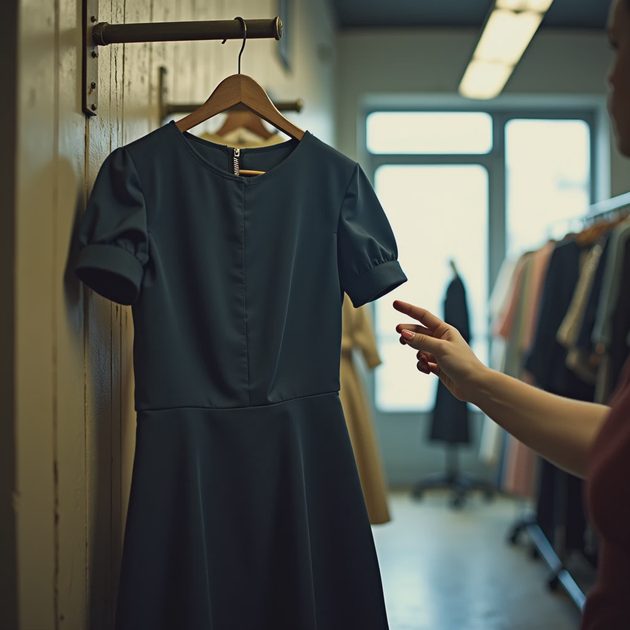
I have stood in a thrift shop fitting room, surrounded by dresses I wanted to love, and talked myself into every single one of them. The color is perfect. The era is right. The price is absurdly low. And somewhere, in the back of my mind, a quiet voice is saying: You will not wear this. You will hang it in your closet, look at it for two years, and then donate it back. I've gotten better at listening to that voice.
What follows are the seven signs I now watch for — not in the fitting room, but before I even get there. These are the quiet, physical tells that a secondhand dress is better admired on the hanger than brought home to your closet. Some of them I learned from patient mentors. Most of them I learned by getting it wrong.
Sign One: The Seams Tell a Story the Outside Is Hiding
The first thing I do now, before I even check the size or the price, is turn the dress inside out. The outside of a garment tells you what it wants to be. The inside tells you what it actually is.
I'm looking at the seam finishes. On a well-made vintage dress, the seams will be finished — bound with tape, French-seamed, or at the very least neatly serged or pinked. The stitching will be even, with no loose threads, no gaps, no places where the needle clearly skipped or the tension went wrong. The seam allowance will lie flat, not pucker or curl.
A dress with unfinished seams — raw edges, no binding, threads already unraveling — is a dress that was made quickly and cheaply. It might have survived decades in a closet, but it will not survive regular wear. The first time you wash it or move through a long day in it, those raw edges will begin to fray. You'll find little threads on your tights, on your chair, on the floor of your apartment. The dress will start to disappear, fiber by fiber.
I also check for signs of previous alteration. A seam that's been taken in and then let out again will show old needle holes. A hem that's been raised or lowered multiple times leaves a trail of creases and stitch marks. Alterations aren't always a dealbreaker — some of my favorite pieces were altered by previous owners — but they tell you the dress has been through changes that may affect its current shape and stability. If the alterations were done poorly, with mismatched thread or uneven stitching, the dress may not hang correctly on your body, and correcting someone else's bad tailoring often costs more than the dress itself.
Sign Two: The Fabric Feels Wrong Against Your Skin
This sounds obvious. It is not obvious in a thrift shop, where the lighting is dim and the air is stale and you're already a little overstimulated by the sheer volume of things. In that environment, it's easy to talk yourself into a fabric that feels "fine" or "not that scratchy" or "probably better with a slip underneath." I have done this. I have brought home a dress that felt "fine" in the shop and unbearable twenty minutes into my day.
Now I do a fabric test that takes thirty seconds. I turn the dress inside out and press the interior side seam — the most intimate part of the garment, the part that will sit closest to your skin — against the inside of my wrist or the crook of my elbow. Those areas are sensitive in the same way your torso is sensitive. If the fabric prickles, itches, or feels plastic-like within ten seconds, it will feel ten times worse after an hour on your body.
I pay particular attention to three fabric offenders:
Unlined wool.
Some vintage wool is soft enough to wear against the skin. Most is not. An unlined wool dress will itch, especially where the seams hit the waist and the underarms. If the wool is coarse or feels dry and brittle — a sign of age and poor storage — leave it. A slip can help, but a slip won't solve the problem if the wool is genuinely uncomfortable.
Stiff synthetics.
Vintage polyester from the 1960s and 1970s can be surprisingly durable, but it can also be stiff, hot, and completely unable to breathe. If the fabric crinkles loudly when you move it, or feels like it would trap heat against your skin, imagine wearing it on a warm day, on a crowded train, in a room without air conditioning. If that image makes you uncomfortable, the dress is not for you.
Damaged silk.
Silk that's been stored poorly, exposed to too much light, or cleaned too aggressively will lose its integrity. It may look fine on the hanger, but when you touch it, it will feel dry, papery, or brittle instead of fluid and soft. This kind of silk is prone to splitting — you'll be wearing the dress, reach for something, and hear the sickening sound of fabric giving way. If the silk doesn't feel like water in your hands, leave it behind.
Sign Three: The Zipper Resists You
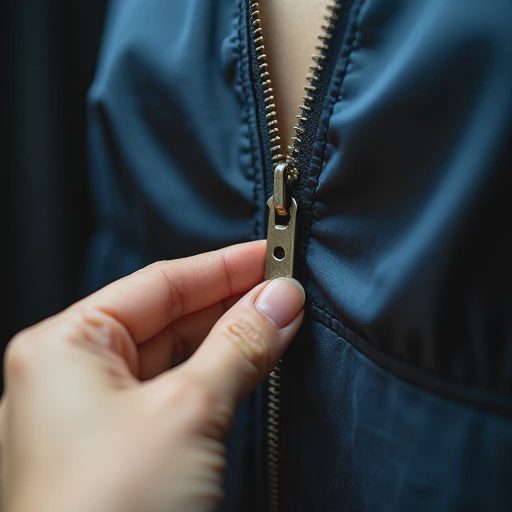
A zipper is a small thing until it's not. A zipper that sticks, catches, or refuses to close smoothly in the fitting room will only get worse with wear. And vintage zippers — especially metal ones from the 1940s through 1960s — are not always easy to replace. The zipper is often sewn into the structure of the dress in a way that requires a skilled tailor to extract and reinsert, and the cost of that labor frequently exceeds what you paid for the dress itself.
I test the zipper three times. Open, close, open, close, open, close. I'm checking for:
Smoothness. Does the pull glide, or does it catch on the teeth? A catch might mean the teeth are misaligned, and misaligned teeth eventually become a zipper that won't close at all.
Gapping. Does the zipper lie flat, or does it gape away from the body? A zipper that pulls away from the fabric is a sign that the dress is strained — either too tight on you, or the fabric around the zipper has shrunk or warped over time.
The stop. Does the zipper stay closed at the top, or does it slowly begin to unzip itself the moment you let go? A zipper that self-opens is a zipper that has lost its grip, and it will betray you in public.
Also, check the zipper tape — the fabric strip the teeth are attached to. If the tape is fraying, pulling away from the dress, or visibly discolored, the entire zipper will eventually need to be replaced. Factor that into your decision. A dress that needs a zipper replacement is not a twenty-dollar dress. It's a twenty-dollar dress plus a sixty-dollar tailoring bill.
Sign Four: The Lining Is Sending a Distress Signal
I wrote about lining checks in a previous Thrift Notes piece on vintage blazers, but dresses have their own lining language, and it's worth paying attention to. The lining of a dress has a harder life than the lining of a blazer. It sits against the skin for hours. It absorbs sweat and friction. It's pulled and stretched every time you sit down, stand up, or reach for something. A dress lining in poor condition is a dress that's been through more than it can handle.
Here is what I look for:
Underarm staining.
This is common in vintage dresses, especially silk and rayon linings. A faint yellowish shadow can sometimes be cleaned. A dark, stiff, or crusty stain is permanent, and it will smell — maybe not in the shop, but the moment your body warms the fabric up. Trust me on this. I learned it the hard way.
Shattering.
Silk linings, particularly from the 1920s through 1940s, are prone to shattering — a phenomenon where the silk fibers break down and split along seams and stress lines. A shattered lining looks like it's been slashed with tiny, parallel cuts. This cannot be repaired. The lining will need to be entirely replaced, which is expensive and, for a dress with intricate construction, sometimes impossible.
Shrinkage.
A lining that's shorter than the outer fabric, pulling the hem up or causing the skirt to bunch, has been washed or dry-cleaned incorrectly. The outer fabric may look fine, but the lining has shrunk, and there is no way to unshrink it. The dress will always hang wrong. You'll always be tugging at the hem. Leave it for someone who doesn't mind a tailoring project — or who plans to remove the lining entirely.
Sign Five: The Shoulders and Armholes Don't Move With You
I mentioned in a previous essay that shoulders don't forgive, and it's just as true for dresses as it is for blazers. A dress with shoulder seams that don't sit at the edge of your actual shoulder, or armholes that cut into your armpit or gape open, is a dress that will make you miserable.
In the fitting room, I do what I call the reach test. I lift both arms forward, as if reaching for a book on a shelf. I lift them sideways, as if reaching for a coat on a hook. I bring my arms in front of my body, as if hugging someone. If the shoulder seam shifts dramatically, if the armhole digs in or pulls the entire bodice upward, the dress does not fit the architecture of your body. And unlike a hem or a waist, armholes and shoulder seams are extremely difficult and expensive to alter.
Vintage dresses from different eras have different armhole shapes. 1940s dresses often have higher, tighter armholes. 1950s dresses tend to have slightly more ease. 1960s shifts can have armholes cut for a narrower shoulder than many modern women have. Pay attention to how the armhole feels when your arm is at rest, and pay more attention to how it feels when your arm is in motion. A dress that only works when you stand perfectly still is not a dress for real life.
Sign Six: The Hem Is Telling You Something About Proportion
Hemlines can be altered. I've altered plenty of them. But the hem of a vintage dress also contains information — about the original design, about whether the dress has been altered before, and about whether the current length will work with your body and your life.
First, I check whether the hem has already been altered. Look at the hem allowance — the amount of fabric folded up from the bottom. A generous hem allowance, two inches or more, is a gift. It means you can let the hem down if you want more length. A narrow hem allowance, under an inch, means the dress is at its maximum length. If it's too short for you, there's nothing to be done.
Second, I check whether the original hemline suits the dress's silhouette. A 1950s full skirt that's been shortened too much loses its proportion — the skirt becomes boxy rather than graceful. A 1940s bias-cut skirt that's been lopped off loses the fluid movement that made it beautiful. If the hem has been altered and the proportions look off, trust your eye. That off-ness will bother you every time you wear it.
Third, I think about my actual life. A hem that hits at exactly the right point when I'm standing still in a fitting room might be too short when I sit down, too long when I walk up stairs, too delicate for a windy day. I ask myself: can I wear this dress on the subway? Can I wear it to a dinner where I'll be sitting for two hours? Can I wear it on a breezy afternoon without constantly adjusting it? If the answer is no, the dress belongs on the rack, not in my closet.
Sign Seven: You're Already Making Excuses Before You've Left the Shop
This is the softest sign on the list, and the one it took me the longest to trust. If I'm standing in the thrift shop, holding a dress, and already composing the story I'll tell myself to justify the purchase — "I'll get it tailored," "It'll work with a slip," "I just need to find the right shoes," "It's such a good deal, I can't pass it up" — the dress is probably not right for me.
A dress that belongs in your life doesn't require a preemptive defense. You try it on, and it slots into your wardrobe like it was already there. It works with the shoes you're wearing. It feels good when you sit down. It doesn't need a slip, or a tailor, or a specific occasion that hasn't been scheduled yet. It's ready, and you're ready, and the only question is whether you want to wear it home or carry it in a bag.
The dresses I regret buying are the ones I talked myself into. The dresses I still wear, years later, are the ones that talked me into nothing — they just quietly proved themselves, in the fitting room and on the street and through the long, ordinary days that make up a life.
None of this is about being ruthless or joyless in the thrift shop. Joy is the point. But the deepest joy in vintage clothing doesn't come from the purchase — the moment of finding, the thrill of the price, the fleeting satisfaction of something new. The deepest joy comes from wearing. From reaching for a dress on a Tuesday morning and knowing it will feel as good as it looks. From walking through a day without once adjusting, tugging, or apologizing for what you put on your body.
A dress that's better on the rack is still a beautiful dress. It's just not your beautiful dress. Learning to see the difference is not about becoming a stricter shopper. It's about becoming a more honest one. And the honesty, eventually, feels better than the purchase ever did.

No letters yet — be the first to write.