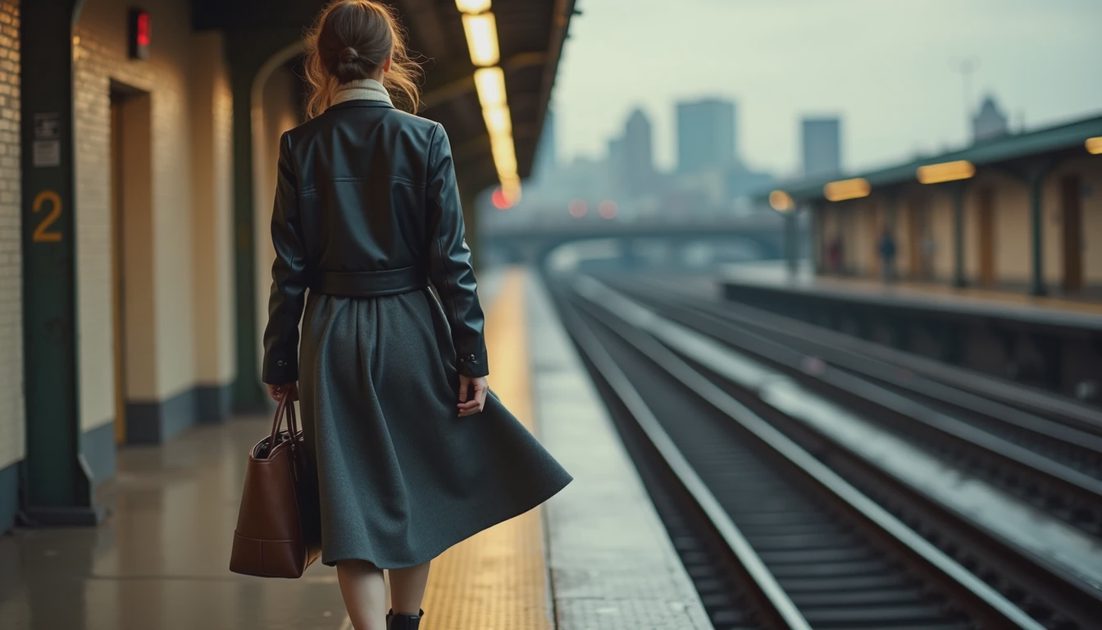
There is a particular kind of heartbreak that happens when a beautiful vintage outfit meets public transportation unprepared. I've experienced it. A full midi skirt that turned into a sail on a windy above-ground platform. A narrow pencil skirt that made taking the stairs at Atlantic Avenue feel like an Olympic sport. A delicate fabric that snagged on a subway seat before I even reached my stop. Each time, I learned something.
Last Tuesday, I set myself a small challenge: wear a vintage skirt — a proper, romantic, mid-century skirt — for a full day that involved the L train, a transfer at Union Square, a walk through downtown Brooklyn, and a coffee meeting that ran late enough to put me back on the train during rush hour. The skirt had to survive all of it without making me feel restricted, self-conscious, or like I was wearing a costume that didn't belong to my actual life.
Here's what I wore, why I chose each piece, and what I've learned about making a vintage skirt truly commute-worthy.
The Skirt: Why This One and Not Another
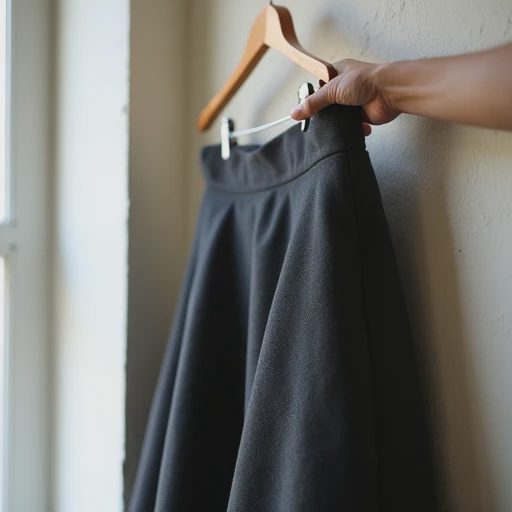
The skirt in question is a 1950s wool A-line in deep charcoal — unlined, mid-weight, with a hem that falls just below the knee. I found it two winters ago at a thrift shop in Greenpoint, and it had already been shortened once, probably in the 1970s, judging by the thread color. That alteration turned out to be a gift. The original length would have been closer to mid-calf, which on my frame reads elegant but stationary. The post-alteration length gives me full range of motion while preserving the period silhouette.
I chose this skirt over other vintage options for three specific reasons that had everything to do with the subway, not the mirror.
First, the fabric weight.
Wool of this weight — not heavy coating wool, but a firm suiting wool with a bit of body — resists wind without stiffening. On an above-ground platform with a February gust coming through, a lighter rayon or silk skirt would have pressed flat against my legs or billowed in a way that feels cinematic but looks unsteady. This wool held its shape. It moved enough to look alive, but not enough to misbehave.
Second, the unlined construction.
This might seem counterintuitive — lining often adds structure — but an unlined wool skirt breathes on a heated train car and doesn't cling to tights the way a static-prone lining can. It also dries quickly if you get caught in a drizzle walking to the station. I learned this the hard way with a lined silk skirt that stayed damp through an entire morning meeting.
Third, the hem weight.
A-line skirts from this era often have a slightly weighted hem — not a visible hem tape, just the natural heft of a deep folded hem in wool. That weight keeps the skirt from flipping up in the wind or riding up when you sit. On a subway bench, the hem stayed put. Standing on a windy platform, the skirt moved as one piece rather than fluttering in sections. Small physics, enormous difference.
The Shoes: Flat, Grounded, Deliberate
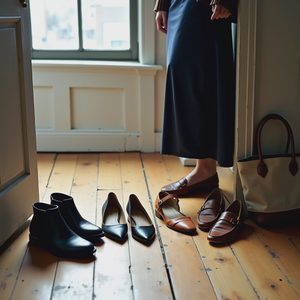
I wore flat leather ankle boots — the same black rubber-soled pair I wrote about in a previous Soft Focus piece, the ones that never get compliments and never let me down. I want to be very specific about why flats mattered here, because the instinct with a vintage skirt is often to reach for a heel.
Heels change the math. A heeled boot or pump shifts your posture, shortens your stride, and makes you more careful on stairs — all of which work against the kind of fluid, unselfconscious movement that makes a vintage outfit feel like clothes instead of a costume. On the subway, careful is the enemy of capable. I needed to climb stairs two at a time if the G train was arriving. I needed to stand steadily on a moving car without gripping the pole. I needed to walk twelve blocks from the station to the café without thinking about my feet once.
The flats also changed the silhouette in a way I've come to prefer. A 1950s A-line skirt with heels reads quite dressed — almost formal. With flat boots, the same skirt relaxes. It becomes something a woman might actually wear to travel across a city, not just to stand beautifully in a foyer. The contrast between the skirt's femininity and the boots' practicality creates a tension I find more interesting than a head-to-toe polished look.
The Layers: What Went Under and Over
On top, I wore a fitted merino wool turtleneck in cream — vintage, but barely. It's from the 1990s, unlabeled, found in a thrift shop bin for five dollars. The neck sits close without choking, and the sleeves are long enough to tuck into the wrist of my coat.
Over the turtleneck, a cropped leather jacket — 1970s, soft black lambskin, unlined, with a zip front and no collar. Not a biker jacket. Something quieter. A jacket that says "I ride the subway" rather than "I ride a motorcycle."
This layering system worked for two reasons that became clear only over the course of the day.
Temperature range.
The subway platform was cold. The train car was warm. The café was somewhere in between, and the walk back was windy. A single heavy coat would have had me sweating on the train and shivering on the platform. The fitted turtleneck plus the cropped leather jacket meant I could unzip on the train, zip up on the platform, and never feel like I was fighting the thermostat. Vintage dressing in a city means dressing for microclimates, and microclimates demand layers that actually work in combination, not just layers that look good together in the mirror.
Silhouette balance.
The A-line skirt creates volume from the waist down. A chunky sweater or an oversized coat on top would have tipped the proportion into tent territory. The fitted turtleneck gave a clean, narrow upper half, and the cropped leather jacket ended right at the waist — the exact point where the skirt began to flare. The eye could follow the line without interruption. Proportion is never about one piece in isolation. It's about where one piece ends and the next begins.
What the Subway Taught Me That the Mirror Didn't
The mirror told me the outfit was pretty. The subway told me whether it was functional. Here is the list of things that happened during the day that the mirror could not have predicted — and why the skirt passed every test.
The stair test.
Union Square station has a long staircase from the L train to the 4/5/6 platform. I climbed it at a normal pace, with a tote bag on one shoulder, without once needing to gather the skirt or adjust my stride. The A-line cut gave my knees full clearance. A pencil skirt would have failed here. A very full circle skirt would have required one hand to manage the volume. The A-line split the difference perfectly.
The seat test.
During rush hour, I actually got a seat — a minor miracle — and sat for six stops without the skirt pulling at the waistband or riding up at the knees. The wool had enough body to stay put but enough softness to drape over my legs without tenting awkwardly. When I stood up, one quick smooth of the fabric and it fell back into place. No crease marks, no static, no fuss.
The wind test.
The walk from the station to the café involved a stretch of open street where the wind always channels between two high-rises. The skirt moved — it's a skirt, not a spell — but it never flipped up or wrapped around my legs. The weighted hem did its quiet job. I didn't have to do the awkward one-hand-pressing-down move that communicates to everyone on the sidewalk that your outfit is thinking about betraying you.
The bag test.
I carried a medium leather tote with a book, a notebook, my wallet, and a small umbrella. The tote sat against my hip on the same side where the skirt flared. The fabric didn't catch on the bag hardware. The skirt didn't twist or pull. This sounds small, but a skirt that tangles with your bag every ten steps becomes unbearable by hour three. This one didn't.
Why the Outfit Felt Like Me, Not a Costume
Here is the part that matters most and is hardest to explain. All day — on the train, on the street, in the café, walking home — I felt like myself. Not a version of myself dressed up as a 1950s housewife or a film noir secretary. Just Clara, in a skirt that happened to be old and beautiful, moving through a city that doesn't pause for beautiful skirts.
That feeling is the entire point.
Vintage style that only works in photographs, in a particular pose, in a controlled environment, is not style I'm interested in. I want clothes that can handle real life — subways, weather, long walks, unexpected delays, and the thousand small physical negotiations that make up an ordinary day in a city. This skirt handled all of it. The wool had resilience. The hem had weight. The waist sat where my waist actually is, not where a 1950s patternmaker thought a waist should be.
If I had worn a crinoline underneath — something I've tried, and loved, for the right occasion — the outfit would have become a production. I would have been managing it all day instead of living in it. The decision to skip the crinoline, to let the wool hold its own shape, was the difference between wearing a vintage skirt and performing one.
Style should survive real life. Not just the photograph, not just the first impression in the hallway mirror, but the full arc of a day that includes wind, stairs, a crowded train car, and a walk that lasts longer than you planned. A good vintage skirt can do all of that — if you choose the right one, pair it with the right shoes, and let it move through the world the way it was originally designed to. Not as a museum piece. As clothing.
Pretty is easy. Personal is harder. And functional, on public transportation, is the hardest style achievement of all. This skirt earned its place in my closet — and on the L train.

No letters yet — be the first to write.