There’s something about the 1940s woman that feels both grounded and cinematic. She’s the kind of presence you notice in an old photograph—not because she’s trying to be noticed, but because her silhouette is so intentional, so clearly her own. I’ve spent years studying decade style, and the 1940s woman remains one of the most referenced yet most misunderstood figures in vintage fashion. Too often she’s reduced to a costume: a victory roll, a red lip, and a swing dress. But the real 1940s woman was a study in balance—strength and softness, resourcefulness and elegance. She had to be. The war years demanded practicality, and the post-war years demanded polish. And somehow, she made both look natural.
If you’ve ever wanted to bring that energy into your own wardrobe without feeling like you’re wearing a period piece, you’re in the right place. This isn’t about recreating a museum display. It’s about understanding why the 1940s woman dressed the way she did and picking up the pieces—literally and figuratively—that still make sense today. The silhouettes, the fabrics, the way a simple blouse can hold a whole mood. So let’s talk about the 1940s woman as a style teacher, not a costume shop inspiration.
The Silhouette That Changed Everything
The 1940s woman’s silhouette is arguably the most wearable of all the vintage decades. Unlike the 1950s, which took the hourglass and practically corseted it into submission, the 1940s kept things a little looser, a little more practical. Think padded shoulders that gave structure without shouting, a nipped waist that defined rather than constrained, and a skirt that hit just below the knee—maybe narrower, maybe slightly A-line, but always moving with you. The shoulders matter most. They create a strong horizontal line that makes the waist look smaller naturally, and they frame the face with an architectural softness. I’ve found that a jacket or blouse with subtle shoulder padding instantly pulls an outfit together, even with modern jeans or a simple midi skirt.
Key Pieces Every 1940s Woman Owned
If you’re building a small capsule inspired by the 1940s woman, start with these five pieces. First, a pair of high-waisted wide-leg trousers. The 1940s woman wore trousers more than is often remembered—especially during the war, when women worked in factories and farms. These weren’t the baggy 1930s pants or the tight 1950s capris; they were tailored, often cuffed, and sat at the natural waist. Second, a blouse with a soft bow or collar detail. Blouses were feminine but efficient, often in rayon crepe or cotton broadcloth. Third, a pencil skirt or an A-line midi. The pencil skirt became iconic in the 1940s, but it had a little more ease than the tight 1950s version—enough to walk comfortably. Fourth, a well-structured jacket. The 1940s jacket often had a nipped waist and strong shoulders, almost like a tailored peplum without the drama. Fifth, practical but elegant footwear: a low heel or a sturdy pump. The 1940s woman wasn’t tottering on stilettos; she wore shoes she could actually walk in.
Fabrics and Details That Matter
The textures of the 1940s woman’s wardrobe tell a story of both scarcity and creativity. Rayon was everywhere, often printed with small florals or geometric patterns. Wool suiting and wool crepe were common for cooler months, and there was something about how a wool twill skirt held its shape that modern poly blends just can’t replicate. Seamed stockings were the finishing touch—even when fabric was rationed, a woman would carefully draw a line up the back of her leg with makeup if she couldn’t get real stockings. That attention to detail, that refusal to let a look feel incomplete, is the heart of 1940s woman dressing today. Small touches: a beret tilted just so, a pair of leather gloves, a brooch on the lapel. You don’t need everything. One or two deliberate details and the whole look lands.
Making It Wearable Today
Here’s where the 1940s woman becomes your style ally rather than a historical footnote. You don’t need an entire vintage wardrobe to capture her spirit. Start with one foundation piece: a pair of high-waisted trousers or a structured skirt. Wear it with a simple cashmere sweater or a fitted tee. Add a jacket with light shoulder padding—try thrift shops, especially men’s suiting sections. If you find a rayon blouse with a little pussy bow or a notched collar, you’ve hit the sweet spot. Footwear today is easier than ever: a low block heel, a loafer, or even a clean white sneaker can work if the rest is tailored. The key is not to overthink it. The 1940s woman didn’t have a huge wardrobe; she repeated pieces and changed the effect with a scarf, a hat, or a change of blouse. That kind of intentional repetition is what makes a personal style feel collected rather than crowded.
A Few Styling Notes from My Own Closet
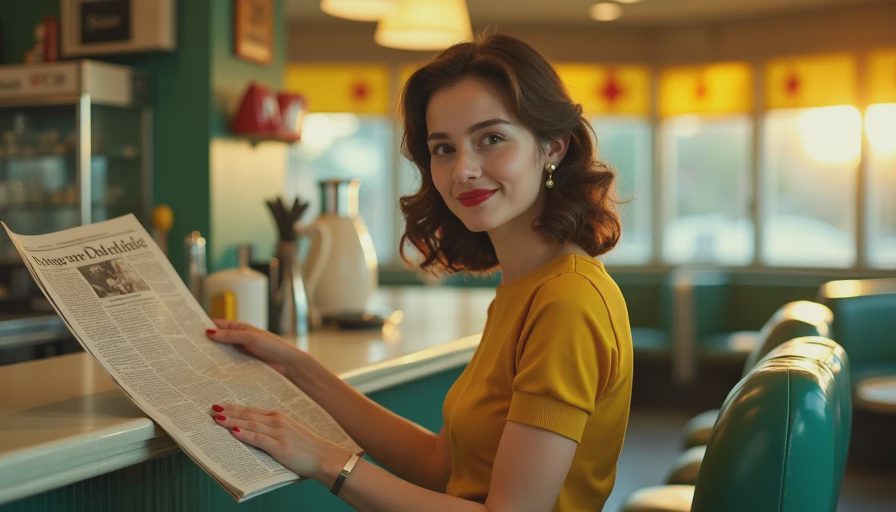
I’ve owned a pair of navy wool high-waisted trousers for years. They were a lucky find at a thrift store in Williamsburg—no label, but clearly from the 1940s or a very good reproduction. They’re cuffed, sit at my natural waist, and have a subtle front pleat. Every time I wear them, I feel like a 1940s woman in the best sense: put together but not fussy. I’ll pair them with a crisp white blouse and my grandfather’s old watch, sometimes a vintage straw hat if I’m feeling brave. The outfit works for a coffee meeting, a gallery opening, or a Tuesday. I think that’s the real lesson. The 1940s woman dressed for her life, not for a photograph. She wanted to move, work, love, and still look like herself at the end of the day. When I figure out how to dress that way, it’s always the pieces that feel like they’ve been with me the longest that get it right.
If you’re curious about exploring more decades, I’d suggest starting with the 1940s woman because her style is the most forgiving. It doesn’t demand perfection. It just asks you to pay attention to line, texture, and the small choices that turn an outfit into a mood. That’s a lesson I come back to again and again. Pretty is easy. Personal is harder. And the 1940s woman knew that better than anyone.

No letters yet — be the first to write.