I once owned a dress that shouted. It was printed, ruffled, and impossible to ignore. Every time I wore it, someone complimented it. Every time I wore it, I felt slightly separated from myself — as if the dress had walked into the room and I was just the woman carrying it. I kept it for two years before admitting the truth: we weren't right for each other.
The dress I want to write about today is the opposite of that dress. It doesn't shout. It doesn't demand. It enters a room the way a thoughtful person enters a conversation — present, composed, and in no hurry to be the loudest thing there. This is the kind of dress I've learned to trust most. The kind that makes a quiet entrance, and then stays.
The Dress Itself: What It Is and Where It Came From
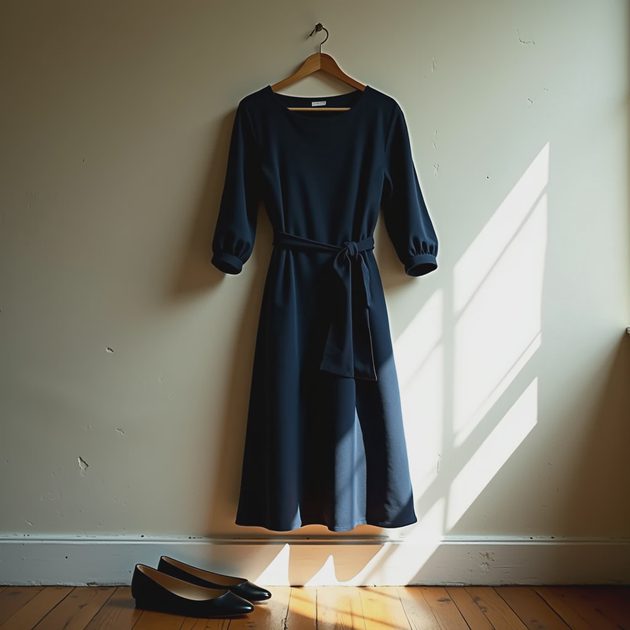
It's a late-1950s day dress in deep navy blue silk crepe de chine — a fabric so fine it feels almost liquid when it moves. No pattern, no embellishment, no contrasting trim. The neckline is a simple boat, wide enough to show the collarbones but not so wide it slips. The sleeves are three-quarter length, ending just below the elbow, and the waist is shaped only by a self-fabric tie that pulls gently without gathering or puckering. The skirt falls to mid-calf in a soft A-line that sways when I walk but never swings theatrically.
I found it four years ago in a vintage shop in Park Slope, tucked between a rack of beaded evening gowns and a pile of faded denim jackets. It had no label, no designer tag, no obvious provenance. Just a dress on a hanger, waiting. When I tried it on, the shop owner looked up from her book and said, very quietly, "That one doesn't usually make it to the rack. Someone must have overlooked it."
I didn't overlook it. I paid eighty dollars — more than I typically spent at the time — and I've worn it to gallery openings, to a friend's wedding rehearsal dinner, to a rainy anniversary dinner at a neighborhood bistro, and to at least three job interviews where I needed to feel like the most composed version of myself. It has never once felt wrong for the occasion. That's the first clue a dress is special: it refuses to be limited to one kind of moment.
What Quiet Even Means in Clothing
Before I go further, I should define what I mean by "quiet" in an outfit. I don't mean boring. I don't mean invisible. I don't mean minimalism as an aesthetic — no shade against minimalism, but that's not what this dress is doing.
A quiet dress is a dress that doesn't use volume to make its case. It communicates through silhouette, fabric, and proportion rather than through color saturation, embellishment, or trend recognition. It's not trying to prove anything. It's not competing with the other dresses in the room. It knows what it is, and it lets you discover that slowly rather than announcing it in the first second.
This navy dress taught me that quietness in clothing is a form of generosity. It gives space to the woman wearing it. It doesn't upstage her face, her voice, or her mood. It supports whatever she brings to the room — and then, if you look closely enough, reveals its beauty on its own terms. The drape of the sleeve. The whisper of the hem. The way the light catches the silk.
A loud dress makes you look at the dress. A quiet dress makes you look at the woman, and then, gradually, you notice what she's wearing. That reversal of attention is the whole philosophy in a sentence.
The Silhouette: Softness Without Formlessness
What makes this dress work, structurally, is a silhouette that defines without constricting. The boat neck widens the shoulder line slightly, creating a frame for the face. The self-fabric waist tie allows me to adjust the definition — looser on a day when I want ease, more fitted when the occasion calls for polish. The A-line skirt moves with my walk but doesn't announce itself with every step.
This is not an hourglass dress. It doesn't have darts that point aggressively toward the waist like a roadmap to my ribcage. It shapes itself around my body rather than demanding that my body conform to its shape. That distinction has become one of the most important filters in my closet: does this garment make room for my body, or does it ask my body to make room for it?
The three-quarter sleeve is, in my opinion, one of the most underrated proportions in vintage fashion. It exposes the forearm — the narrowest and most expressive part of the arm — while keeping the upper arm and elbow covered. It means I can gesture when I talk without fabric pulling or bunching. It means the dress works equally well with bare wrists in warm weather and with a trench coat layered over it in cooler months. It's a sleeve that lives comfortably in real life.
The Color: Navy as a Neutral, Navy as a Mood
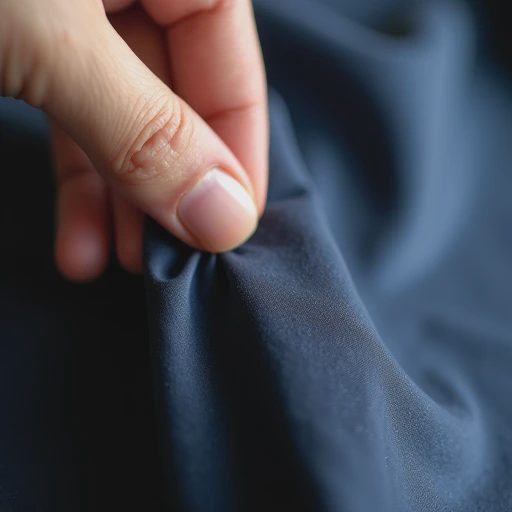
Navy blue is often described as a neutral, and I understand why — it pairs easily with black, brown, grey, cream, burgundy, and most shades of green. But navy is also a mood. It's the color of evening sky before the streetlights come on. The color of deep water. The color of old ink and quiet libraries. It carries an emotional weight that beige and grey don't, but it's softer than black, more approachable, less final.
This dress in any other color — a bright coral, a turquoise, even a soft rose — would be a different dress entirely. The quietness is partly in the color choice. Navy absorbs light rather than reflecting it. It recedes slightly, and then, when you look directly at it, reveals its depth. There's a metaphor in there somewhere about the kind of presence I admire most in women and in clothes.
The silk crepe de chine deepens the effect. Matte enough to look substantial in daylight, but with a subtle, almost imperceptible sheen when the fabric catches a lamp or a candle. It's the difference between a dress that looks one way from across a room and another way up close — a dress that rewards proximity.
How It Feels to Wear It: The Real Test
Here is the part that matters more than any technical description of the dress: what it feels like to spend a day in it.
I wore this dress last month to a small gallery event in lower Manhattan. The space was crowded, warm, lit in that flattering amber that makes everyone look slightly cinematic. I walked from the subway, up three flights of stairs, through two hours of conversation and standing with a glass of wine, back down the stairs, and onto the train home. At no point did I adjust the neckline. At no point did the waist tie come undone or the hem snag on a gallery floorboard. At no point did I feel underdressed or overdressed or like I was wearing someone else's idea of what a woman at a gallery opening should look like.
I felt like myself, in a dress that understood the assignment.
That is the quiet entrance in practice. Not a grand sweeping arrival where heads turn. Not a dress that walks into the room before you do. Just a woman, composed, wearing something that makes her feel capable of whatever the evening asks. People noticed the dress, eventually — a friend touched my sleeve and said, "That fabric is beautiful." Another asked where I found it. But those comments came later, organically, as the evening settled. The dress didn't demand them. It earned them.
What the Dress Taught Me About Collecting a Wardrobe
I said earlier that style should feel collected, not crowded, and this dress is the clearest argument for that philosophy I own. It didn't arrive alone. It joined a closet that already had a navy cashmere cardigan, a pair of charcoal wool trousers, a cream silk blouse, a trench coat. It fit into a family of pieces that shared its values: good fabric, deliberate silhouette, emotional restraint.
When you collect clothes rather than accumulate them, each new piece either deepens the conversation or distracts from it. This dress deepened it. It made other pieces in my wardrobe make more sense. It showed me what a truly quiet piece could do — and then it made me less interested in pieces that could only be loud.
I still have a few loud things in my closet. A printed silk scarf from the 1970s. A pair of red suede heels I wear maybe twice a year. Loud isn't wrong. But loud is seasoning, not the meal. The backbone of a wardrobe, the pieces you reach for on the days that matter and the days that don't, should be built on quiet. On navy silk that falls like water. On boat necks that frame your face without framing it as a performance. On self-tie waists that let you decide how much definition today calls for.
Pretty is easy. Personal is harder. A dress that makes a quiet entrance is personal — it belongs to the woman wearing it, not to an aesthetic or a trend or an idea of what a vintage dress should look like. If I lost my entire wardrobe tomorrow, I would look for this dress first. Not because it's the most beautiful thing I own. Because it's the one that feels most like coming home.


No letters yet — be the first to write.