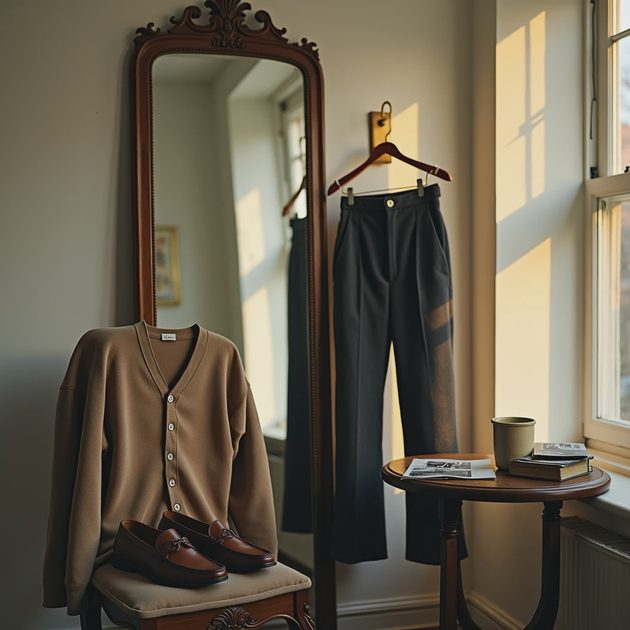
For the first few years of my vintage-obsessed life, I was dressing to look like something. A 1960s film extra. A 1940s librarian. A woman from a photograph I'd saved on my phone, whose name I didn't know but whose skirt I thought about constantly. The results were, by most external measures, successful. People complimented my outfits. Friends said I had "a look." A stranger once stopped me on the street and asked if I was on my way to a costume fitting. She meant it kindly. I smiled and said no, just headed to the grocery store. But the question stayed with me longer than I wanted it to.
What I was doing, though I couldn't have named it then, was wearing vintage as a costume. Not a costume in the theatrical sense — I wasn't walking around in crinolines and gloves — but a costume in the emotional sense. I was dressing as an idea of a woman, curated from films and photographs and the kind of vintage shop that feels more like a museum than a closet. I was reaching for clothes that made me look a certain way, and somewhere along the way I'd stopped asking whether they made me feel like myself.
The difference between looking vintage and looking like yourself is the difference between wearing a reference and wearing a reflection. And it took me years to understand that those are not the same thing.
The Phase Where Everything Had to Be Vintage
There was a stretch — I'll call it my early-to-mid twenties, though it lingered longer than I'd like to admit — when I believed that a good outfit was an outfit composed entirely of vintage pieces. If I was wearing a modern T-shirt under a vintage skirt, I felt like I was cheating. If I reached for a pair of contemporary flats because my vintage heels were destroying my feet, I felt like I had failed some invisible exam. The goal, as I understood it, was total commitment. A head-to-toe period look, or at least the illusion of one.
The problem wasn't that I looked bad. Looking back at photographs from those years, I looked fine. Sometimes I looked lovely. But I didn't look like me. I looked like a woman who had studied old pictures very carefully and reproduced their surface without understanding their depth. The outfits were accurate. They were not alive.
I remember one specific day — a Sunday, unremarkable weather, no special occasion — when I put on a 1950s shirtwaist dress with a full skirt, a petticoat underneath, vintage seamed stockings, and a pair of heeled oxfords that pinched at the toe. I was meeting a friend for brunch at a diner, the kind of place with vinyl booths and unlimited coffee refills. I looked like I was on my way to a garden party in a film about suburban dissatisfaction. My friend, wearing jeans and a sweater, looked at me kindly and said, "You didn't have to get so dressed up." I had, I realized. Not for her. Not for the diner. But because I didn't know how to dress down in my own clothes yet. Every outfit was a production. Every garment had to carry the weight of an era. And the woman underneath all of it — the one who actually existed in the twenty-first century, who liked oat milk cappuccinos and took the subway and stayed up too late reading — was getting lost.
The Piece That Taught Me the Difference
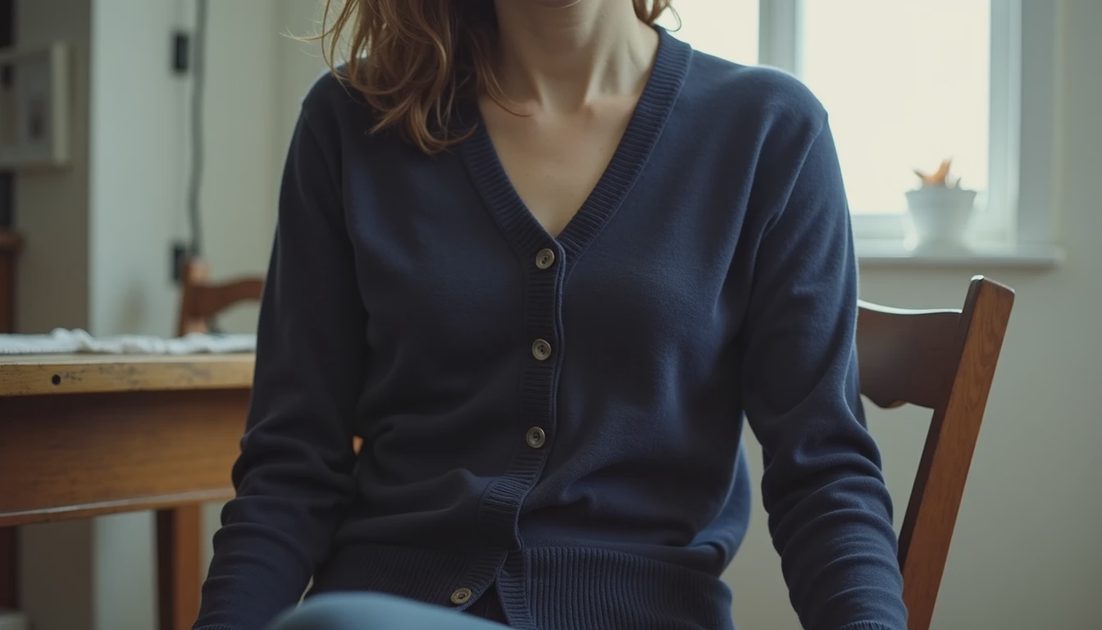
The shift didn't happen all at once. There was no dramatic closet purge, no single moment of clarity. But there was one garment that started teaching me the difference between looking vintage and looking like myself, and it was not a piece I would have chosen for that job.
It was a simple navy blue merino wool cardigan from the 1990s. Not the kind of vintage that photographs well. Not the kind of piece that would ever appear in a street style roundup or a mood board about old Hollywood glamour. It had no remarkable details — a V-neck, five small buttons, a ribbed hem. I bought it at a thrift shop for eight dollars because it was soft and I was cold. I didn't think of it as a vintage purchase. I thought of it as a solution to the problem of having cold arms.
And then I wore it. The next day, and the day after that, and the day after that. I wore it over silk dresses and with wool trousers and tucked into the waistband of skirts. I wore it to cafés and on the subway and to a friend's apartment for dinner. It didn't make me look like any particular decade. It didn't announce itself as vintage at all. What it did was make every outfit I paired it with feel more like mine.
The cardigan taught me something I've been unpacking ever since: vintage clothing works best when it's in conversation with the present, not in flight from it. The cardigan was vintage, technically, but it didn't read as a period piece. It read as a cardigan. A good one, well-made, in a color that flattered me. It served my life instead of demanding I build my life around it. And that distinction — the piece that serves versus the piece that demands — is now the lens through which I evaluate every garment I bring home.
The Questions I Ask Now Instead of "Is It Vintage?"
These days, when I'm standing in a thrift shop fitting room or in front of my own closet in the morning, I don't ask myself whether an outfit looks vintage. I don't ask whether it's accurate to any particular era. I don't ask whether a 1940s style purist would approve of me mixing a 1970s blouse with contemporary trousers.
I ask three questions instead. They've replaced the old litmus test entirely.
Does this feel like me, or does it feel like a version of me I'm trying to perform?
This is the hardest question, because it requires honesty I used to dodge. Some pieces I loved — truly loved, in the way you love a beautiful photograph of someone you don't know — did not feel like me. An impeccably tailored 1960s suit jacket in a pale pink tweed. A full-circle 1950s skirt in a print of tiny roses. A 1930s bias-cut evening gown in liquid gold satin. These were gorgeous pieces. They were not my pieces. I was performing a kind of femininity that looked beautiful in the mirror and felt like a stranger by noon. Letting those pieces go — donating them, gifting them to friends who genuinely lit up when they tried them on — was not a failure. It was clarity.
Can I live in this? Not just stand in it?
A garment that looks perfect when I'm standing still in front of a mirror but becomes a problem when I sit down, reach up, walk three blocks, or take a deep breath is not a garment I can build a life around. I learned this through trial and error — mostly error. The dress that wouldn't let me lift my arms high enough to grab a book from a shelf. The skirt that made taking the subway stairs a negotiation with my own stride. The blouse with sleeves so fragile I spent the whole evening afraid of tearing them. These were costumes, not clothes. Clothes should serve the body in motion, not just the body in a photograph.
Does this piece make my existing wardrobe make more sense, or does it require a whole new wardrobe to work?
A good addition to a wardrobe deepens what's already there. A navy cashmere cardigan made my silk skirts feel more wearable and my wool trousers feel more relaxed. A charcoal A-line skirt worked with blouses I already owned and sweaters I'd had for years. When I buy something now, I think about what it will talk to in my closet. If the answer is "nothing" — if the piece would require me to build a new ecosystem around it — I leave it on the rack. Style should feel collected, not crowded. And a collection implies relationship. Pieces that exist in isolation aren't a collection. They're just accumulation.
Looking Vintage Is a Technique. Looking Like Yourself Is a Practice.
Here is the thing I wish someone had told me at twenty-two, standing in a thrift shop with an armful of beautiful things that belonged to other women's lives: looking vintage is a technique. You can learn it. Anyone can learn it, with enough time, enough research, enough money, enough patience. You can study silhouettes and fabrics and labels. You can memorize decades and designers. You can build a closet full of historically accurate, era-specific garments and put them on your body and look, to the outside world, like a woman who walked out of an old photograph.
But looking like yourself is not a technique. It's a practice. It requires paying attention to how you feel, not just how you look. It requires noticing which pieces you actually reach for on ordinary mornings, not which pieces you wish you reached for. It requires letting go of the fantasy version of your wardrobe — the version that exists for photographs and special occasions and the approval of people who care deeply about period accuracy — and making peace with the real version, the one that gets worn on Tuesdays.
This doesn't mean giving up on vintage. Far from it. My closet is still mostly vintage. But the vintage in my closet now is the vintage that feels like me: a navy silk dress that moves when I walk, a charcoal wool skirt that survives the subway, a fawn cashmere cardigan with a tiny moth hole near the hem that I still haven't mended. These pieces have era — 1950s, 1940s, 1990s — but the era is a footnote, not the headline. The headline is: Clara's clothes. Clara's life. Clara's quiet Tuesday morning, dressed in things that understand her.
What I Kept and What I Let Go
I want to be specific about this, because the idea of "letting go" can sound abstract and noble until you're standing in your own closet trying to decide what stays and what leaves. Here is what I let go of, and what I kept, and why.
I let go of the pieces that required a version of me that doesn't exist. The 1950s wiggle dress that demanded I stand up straight and hold my stomach in for an entire evening. The 1960s box jacket with shoulders so structured they made me look like I was bracing for impact. The Victorian-inspired lace blouse that belonged in a period film and nowhere near a Brooklyn café. These were beautiful pieces, but they were written for a different character. I stopped auditioning for that role.
I kept the pieces that made me feel more at home in my body. The bias-cut silk skirts that move with my walk instead of dictating it. The cardigans — so many cardigans — in navy and fawn and oatmeal and burgundy, soft from decades of wear, reliable as old friends. The trousers with room to sit, with pleats that soften the waist, with hems that break just above my loafers. These pieces don't shout "vintage." They whisper "you."
I let go of the idea that an outfit needs to be entirely vintage to count. This was the biggest shift, and the most freeing. Now I mix without guilt. A vintage cardigan over a modern silk camisole. A vintage skirt with a pair of leather loafers from a contemporary brand. A 1970s scarf tied around the strap of a bag I bought new last year. The mix is the point. The mix is what makes the vintage pieces feel alive instead of archival.
I kept my love for old films, old photographs, old fabrics, old stories. Letting go of costume vintage didn't mean letting go of the things that drew me to vintage in the first place. I still pause at film stills. I still study the cut of a 1940s jacket. I still run my fingers over silk crepe and wool gabardine in thrift shops and feel the same small thrill I felt at twenty-two. The difference is that now I ask: does this belong in my life, or just in my imagination? And I've learned to trust the answer.
The line between looking vintage and looking like yourself is thin but essential. It runs through the heart of every closet, every fitting room, every morning when you stand in front of the mirror deciding who you're going to be that day. Looking vintage is about the past. Looking like yourself is about the present — the body you have, the life you're living, the woman you actually are when no one is photographing you.
Style should feel collected, not crowded. And the collection, if you're doing it right, is a portrait. Not of a decade. Not of an aesthetic. Of you.

No letters yet — be the first to write.